
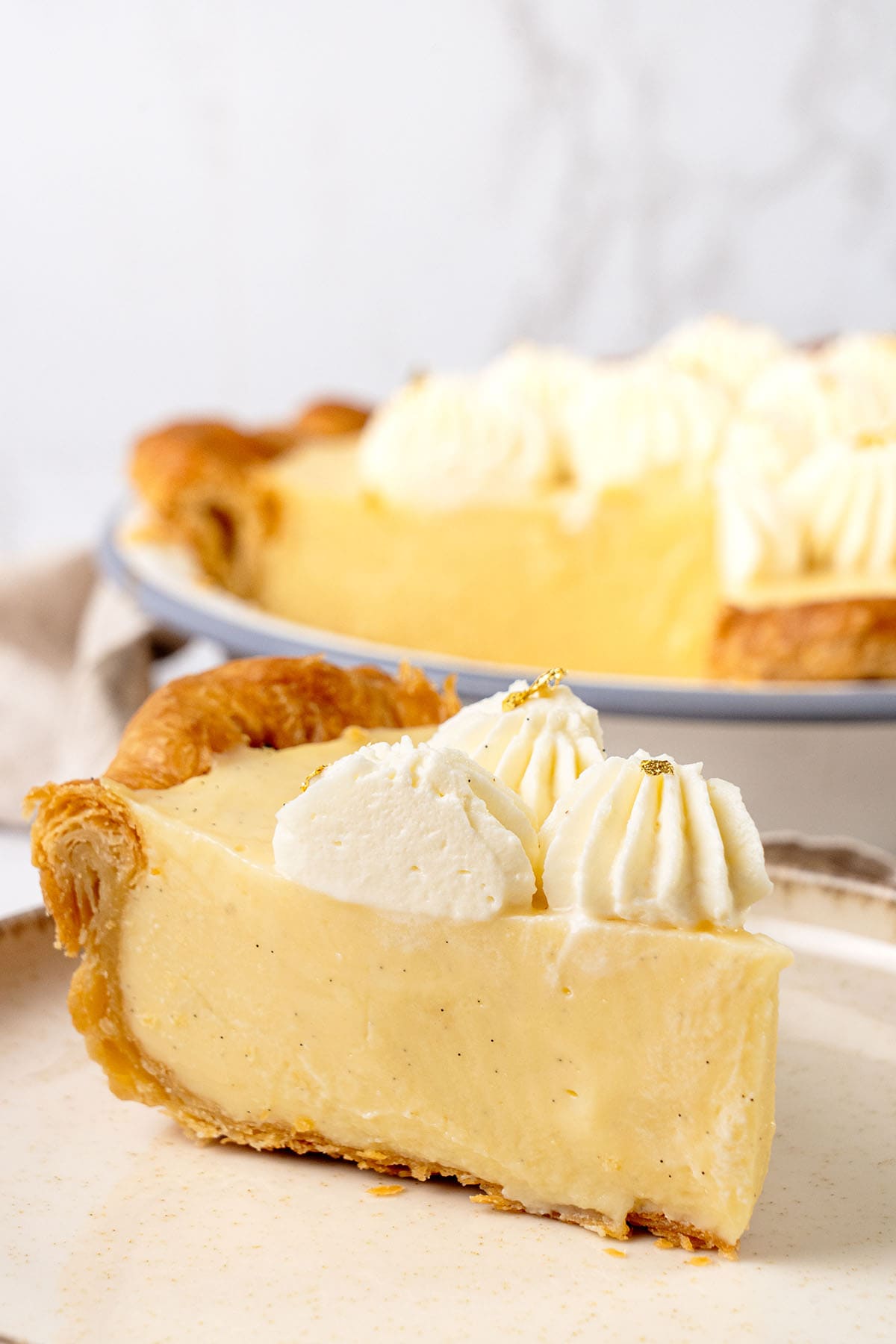
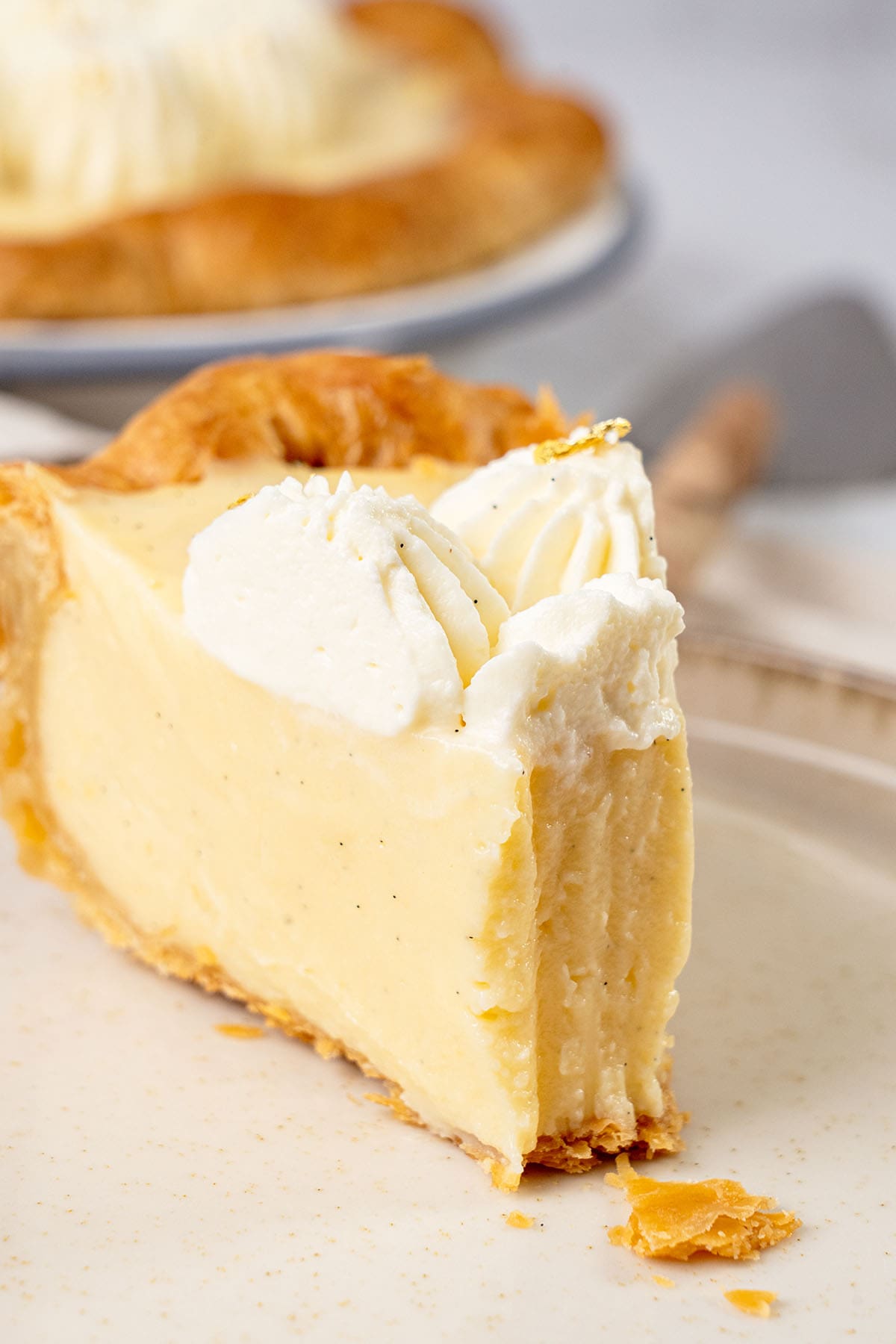
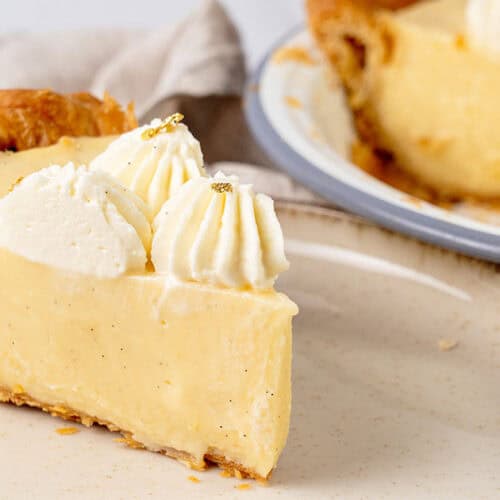
This delicious, easy-to-make vanilla cream pie is a must-have on your dessert table, no matter the occasion! Made with a flaky, homemade pie crust, rich vanilla pastry cream, and fluffy whipped Chantilly cream, it is simple, yet absolutely irresistible. Top it with fresh fruit for a light and flavorful crowd-pleaser perfect any time of the year!
Best Vanilla Cream Pie Recipe
If you’re looking for a vanilla cream pie recipe that's easy enough for beginners yet still made entirely from scratch, you’ve landed in the right place.
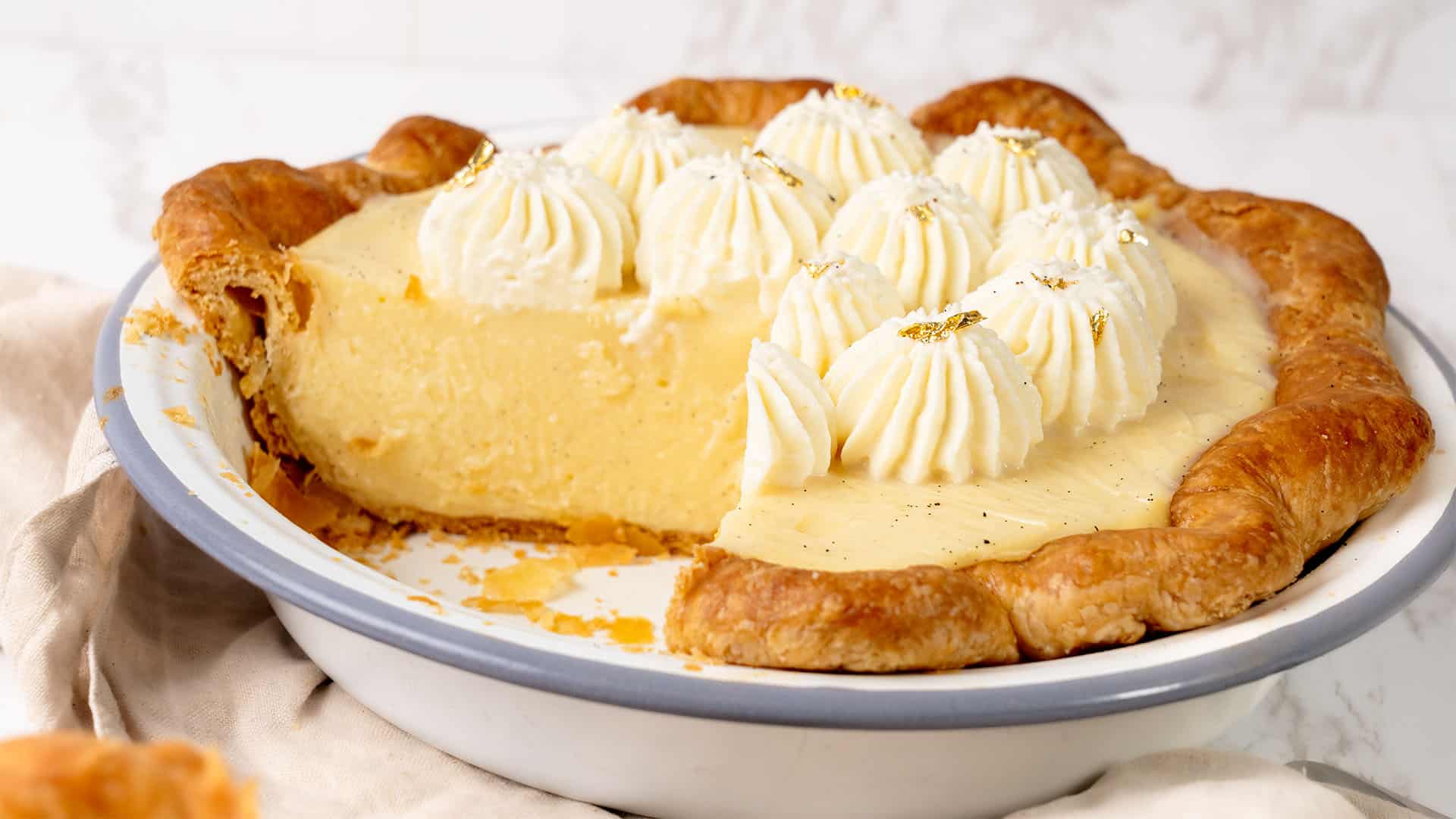
My recipe is built on tested techniques rather than shortcuts. It uses a fully blind-baked crust, so it stays crisp once filled, and real homemade pastry cream versus boxed instant pudding. That alone gives the pie a richer flavor and smoother texture! The Chantilly cream decoration is stabilized with mascarpone for a beautiful finish.
The balance of texture and flavor makes this one of the best vanilla cream pie recipes. Each step is designed to help you avoid common issues like soggy bottoms or a filling that doesn’t set properly, so you can confidently serve a bakery-quality vanilla cream pie.
Katalin's key take on how to avoid soggy pie
A well-done pie should have a crisp base that holds its shape when sliced, not a soggy mess. The good news: soggy crusts are completely preventable!
For single-crust pies with wet fillings and no top layer, fully blind baking the crust makes a real difference. I always pre-bake my pie crusts until deeply golden, so the base is fully baked before adding the filling. To prevent over-browning, cover the edges with aluminum foil.
Brushing on a thin layer of egg wash after removing the pie weights, then returning it to the oven for a few minutes, creates a light barrier that helps prevent excess moisture from the filling from soaking in.
Lastly, using the right amount of thickening agent, such as flour or cornstarch, helps the filling set to a firm, creamy consistency. The pastry cream should be cooked until thick before it goes into the crust, ensuring clean slices and a sturdy base.
Start with the pie dough
Before starting, make sure your butter, flour, and water are very cold. Cold ingredients keep the butter from melting into the flour too quickly, helping preserve the crust's flaky texture. Working in a cool kitchen helps!
Combine your flour, sugar, and salt in a large bowl, then place it in the freezer for 5–10 minutes.

Cut your cold, unsalted butter into small chunks and chill it along with the water and vinegar.
After all your ingredients are nicely cold, add the cold butter to the flour and rub the mixture between your fingers until it resembles coarse sand. It’s okay to leave a few larger butter chunks, as they will melt in the oven and create steam pockets that form flaky layers.

Slowly add the cold water and vinegar, stirring after each addition. Use only enough liquid for an evenly hydrated dough. Too much water can make the dough sticky and, therefore, difficult to work with.

Transfer the dough onto a lightly floured surface. Gently bring everything together without kneading, as overworking the dough will make it dense. Shape it into a disk, wrap it in plastic, and refrigerate it for at least 2 hours. This resting period relaxes the gluten and firms the butter again. Do not skip this step or attempt to speed things up by freezing.

Laminate for extra flakiness
For extra flakiness, I use a simple lamination technique similar to the one in my puff pastry recipe to build extra layers. This step is optional, but so so easy and makes a huge difference in the texture of the final baked pie.
After chilling, let the dough rest at room temperature just until it’s pliable but still cold. If it becomes soft or sticky, re-chill it briefly before continuing.
Roll the dough into a rectangle on a lightly floured surface or a silicone baking mat, then fold the left half over the right, then fold the bottom half over the top. Fold once more for eight layers. Work quickly and avoid adding excess flour, which can dry out the crust.
Wrap it in plastic and refrigerate for at least 2 more hours.

Fully bake the pie crust before filling
Roll the chilled dough into a 10-inch (26 cm) circle. Avoid stretching or forcing it into the pan, as it can cause shrinkage during baking. Keep the dough cold and pliable as you work.
Then, to fully bake the pie crust, continue with the steps outlined in my how to blind bake pie crust tutorial, which includes troubleshooting tips to help you avoid common mistakes. Allow the crust to cool completely before filling.

Make the vanilla pastry cream filling
For the pastry cream, use room-temperature egg yolks and softened butter to help the ingredients emulsify smoothly and create a stable, creamy texture. Sift the dry ingredients - flour and corn starch - to eliminate lumps.
In a large bowl, whisk the egg yolks with the sugar for 1–2 minutes until light and fluffy. Whisk in the dry ingredients until completely smooth, then add the vanilla extract.

Heat the milk over medium heat just until it begins to simmer. Do not let it boil! Slowly pour the warm milk into the egg mixture while whisking continuously to temper the yolks.

Return everything to the saucepan and cook over medium heat, whisking constantly and scraping the bottom and corners of the pan. The mixture will thicken quickly once it reaches a boil.
Whisk continuously for about 1 minute to keep the cream stable. If lumps appear, whisk vigorously or strain the cream while still warm.
Remove from the heat and fold in the butter for a glossy, rich finish. The butter must be room temperature to properly emulsify with the cream.

Fill the pie crust and decorate
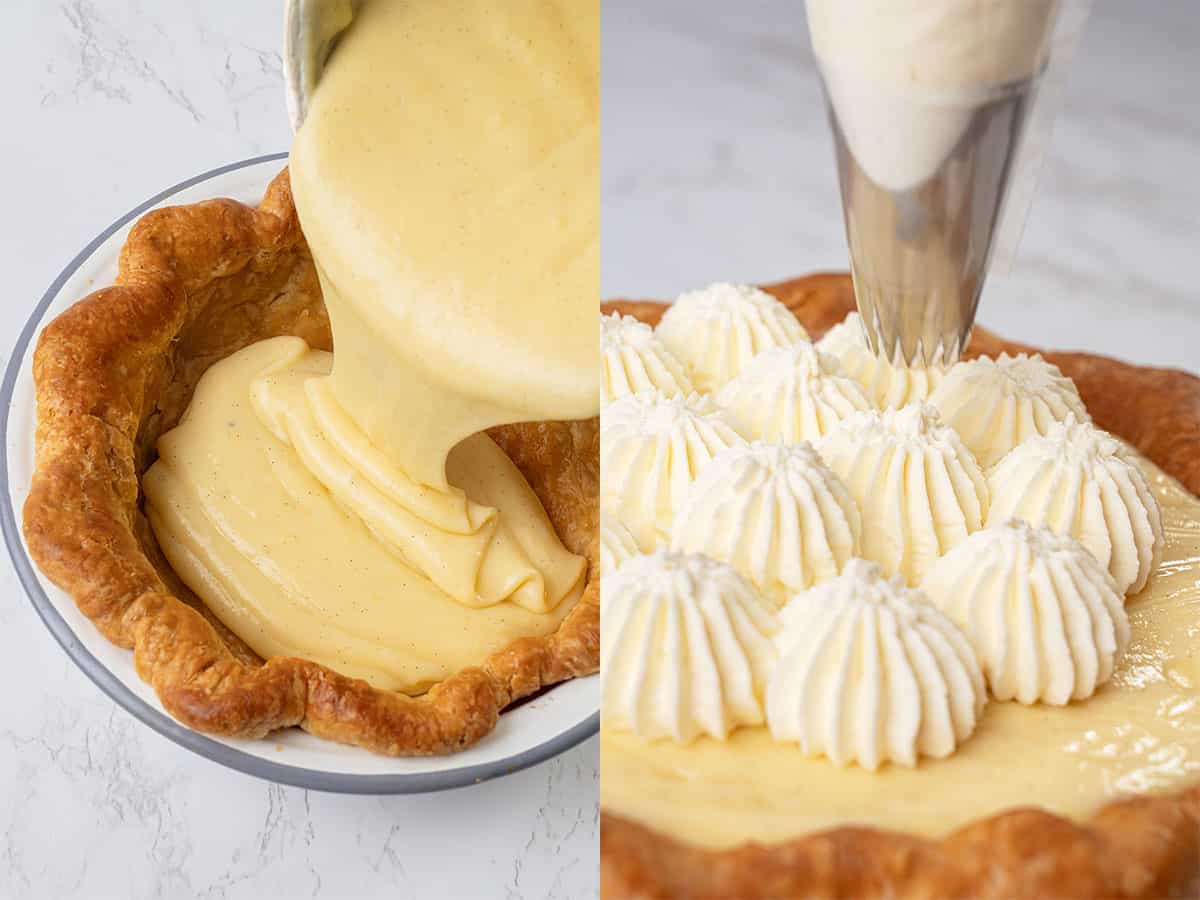
Pour the pastry cream into your cooled pie crust and smooth the top evenly.
Cover the entire surface of the cream with plastic wrap to avoid skin forming on top. Refrigerate for 3–4 hours, or until fully set and firm to the touch.
Just before serving, prepare the Chantilly cream topping. Whip the very cold heavy cream, mascarpone, and sifted powdered sugar with a hand whisk or electric hand mixer until early stiff peaks form. Avoid using a stand mixer, as it is easy to overwhip. Stop as soon as the cream holds its shape.
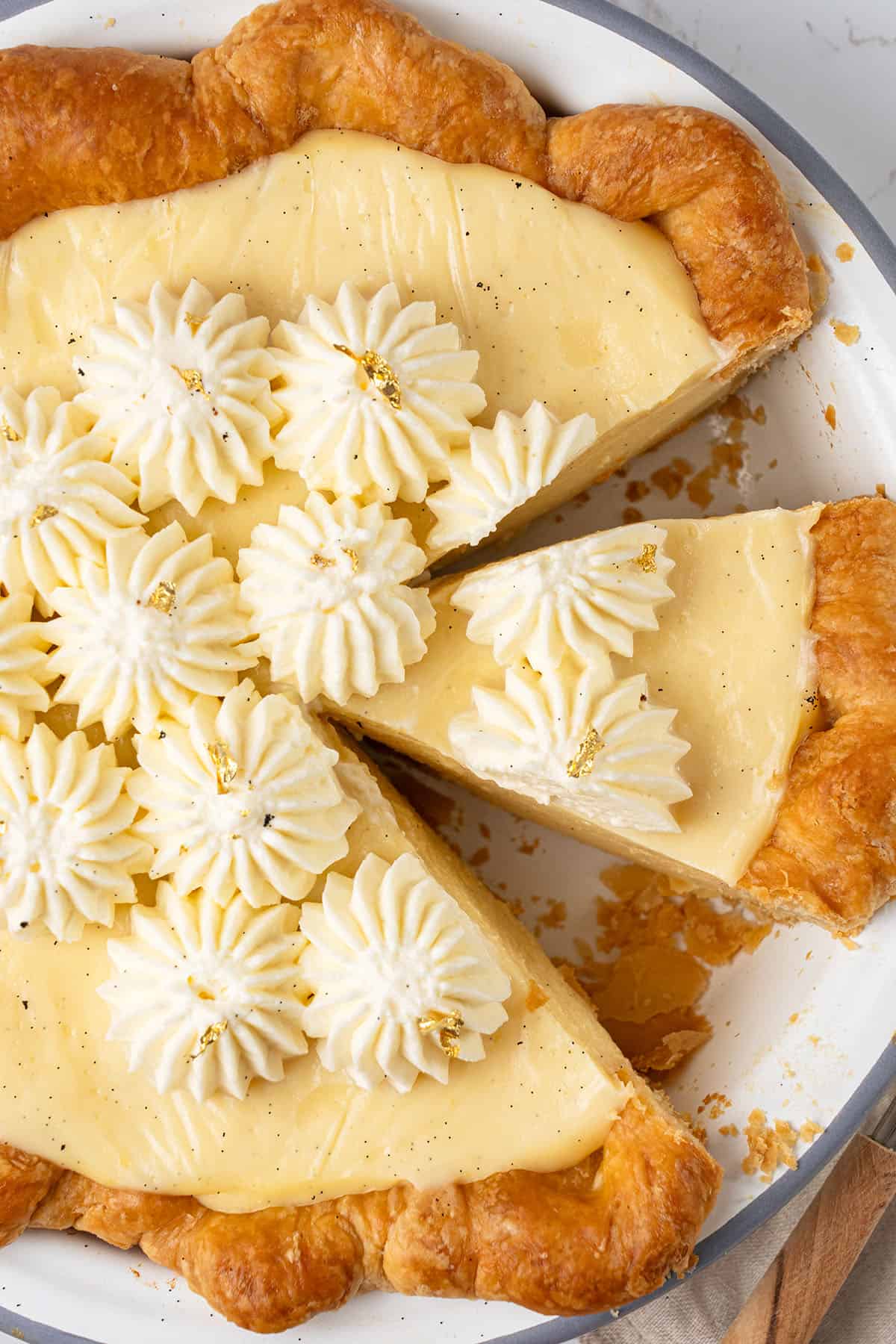
Pipe or spoon the cream over the set vanilla cream pie and enjoy!
Storing & freezing
Store your vanilla cream pie in the refrigerator for 2-3 days. Before serving, let it sit at room temperature for 20-30 minutes.
Do not freeze the filled pie, as the pastry cream will lose its smooth texture once thawed.
However, you can freeze the baked pie crust. Let it cool completely to room temperature, then wrap it tightly in plastic wrap, followed by aluminum foil to prevent freezer burn. Freeze for up to 2 months. Thaw in the refrigerator overnight or at room temperature for about 1 hour before filling. I recommend re-baking at 350°F (175°C) for 5–8 minutes before filling to restore crispiness.
Flavor variations
You can easily customize this vanilla cream pie with different flavors and add-ins.
Swap the vanilla bean flavor for chocolate, as explained in my pastry cream and chocolate Chantilly cream recipes. You can also add grated lemon or lime zest for a citrusy flavor, finely ground instant espresso powder, or warm spices like cinnamon or nutmeg. Avoid using liquid flavoring ingredients, as they add too much moisture.
You can also flavor the pie crust! Give the crust a nutty flavor by replacing some of the all-purpose flour with almond or hazelnut flour, or by adding black sesame seeds as I do in my black sesame tart recipe. You can also enhance or alter the flavor with vanilla extract, cocoa powder, grated citrus zest, or warming spices.
You can also make this pie using my graham cracker crust, as I do in my no-ake apple pie recipe. Or, for an entirely different look, why not try my Oreo pie crust?
Ingredient substitutions
For a gluten-free pie, swap the all-purpose flour for cornstarch in the pastry cream and use a gluten-free pie crust.
Making the creams egg-free or dairy-free is more complicated, as pastry cream relies on eggs and dairy for structure and richness, and Chantilly cream also depends on dairy. For the pastry cream, you can use an egg substitute along with dairy-free butter and milk.
Refer to my guides for heavy cream and mascarpone substitutes to find acceptable alternatives for the Chantilly cream. For the crust, use vegan butter and a vegan egg wash, as explained in my egg wash tutorial.
If avoiding butter, try one of these butter substitutes. To maintain a similar texture, use only high-fat alternatives, such as margarine.
Substituting ingredients may require adjusting ingredient quantities and ratios to achieve similar results. Unfortunately, I cannot provide instructions to accommodate every diet.
Expert tips to make Vanilla Cream Pie
- Handle the dough very gently to avoid overworking it. Do not knead it. Overworked dough results in a tough crust.
- Use pie weights during the first half of blind baking to prevent puffing. After removing them, prick small holes in the crust with a fork to release steam and reduce air bubbles.
- Cook the pastry cream for at least a minute after the first boil, or it may end up too runny. If it becomes too firm, loosen it by folding in lightly whipped cream.
- Add the Chantilly cream just before serving to prevent deflation.
- Chantilly cream can melt, so avoid leaving it out of the fridge for hours, particularly on a hot summer day, this pie should be refrigerated.
- One way to decorate the pie is using a piping nozzle; however, if you don't have one, just use a spoon and pile the cream on top, it will look pretty either way.
What equipment to use
Always use a digital scale for ingredient accuracy. Precise measurements are a must for the best results.
You’ll need both a hand whisk and a rubber spatula to properly combine the ingredients for the pastry cream. An electric hand mixer is necessary for the whipped Chantilly cream. A good rolling pin is also necessary for the pie crust.
This recipe uses a 9-inch/23 cm pie dish.
Try some of my other pies
If you liked this easy vanilla cream pie recipe, you’ll also love my other pies:
- Brownie Pie
- Bailey’s Apple Pie
- Creamy Sicilian Ricotta Pie
- Butterscotch Pie
- No-Bake Pumpkin Pie with Graham Cracker Crust
For even more delicious pies that you can make without heating up the kitchen, check out my roundup of the best easy no bake pies!
Have you tried this recipe?
Please leave a 5-star ⭐️⭐️⭐️⭐️⭐️ rating on the recipe card and consider leaving a comment as well!
Vanilla Cream Pie
Ingredients
Pie crust
- 190 g (1½ cups) All purpose flour
- ¼ teaspoon Salt
- ½ tablespoon Granulated sugar
- 113 g (½ cups) Unsalted butter 82% fat, use it very cold
- 60 g (¼ cups) Water very cold
- 15 g (1 tablespoon) Apple Cider vinegar
Pastry cream filling
- 720 g (3 cups) Whole milk 3% fat
- 150 g (¾ cup) Granulated sugar
- 120 g Egg yolks approx. yolk of 6-7 eggs
- 30 g (¼ cup) Corn starch
- 30 g (¼ cup) All purpose flour
- 1 tablespoon Vanilla extract
- 80g g (⅓ cup) Unsalted butter 82% fat, use it at room temperature to add to the pastry cream as the last step
Whipped chantilly cream decoration
- 80 g (⅓ cup) Heavy cream 36% fat, use it very cold
- 60 g (¼ cup) Mascarpone high fat, use it very cold
- 30 g (¼ cup) Powdered sugar sifted
US customary cup measurement is an indicative figure only. Measure the ingredients with a digital scale by weight (gram). Baking is art but also science which requires precision and accuracy.
Instructions
Pie crust
- This dough makes one 9-inch (23 cm) single-crust pie, exactly what you need to make this recipe.
- In a large bowl, mix the flour, sugar, and salt, then place the bowl in the freezer for 5–10 minutes. Cut the butter into small chunks and chill them, along with the measured water and vinegar.
- Add the cold butter to the flour and rub it between your fingers until the mixture resembles coarse sand, leaving a few larger butter pieces for a flaky texture.
- Gradually add the cold water and vinegar, stirring after each addition. Use just enough liquid to form a dough that’s evenly hydrated but not sticky or dry.
- Turn the dough onto a lightly floured surface and gently bring it together without kneading. Shape into a disk, wrap in plastic, and refrigerate for at least 2 hours before rolling.
- For extra flakiness, consider applying this very easy lamination technique: Remove the pie dough from the fridge and let it rest on the counter for a few minutes until slightly softened but still cold. Roll it out on a lightly floured surface into a rectangle shape. Fold the left half over the right, then fold the bottom half over the top. Fold once more in half to give you eight layers.Wrap the dough in plastic and refrigerate for at least 2 hours before using.
- For a 9-inch (23 cm) pie dish, roll the dough into a 10-inch (26 cm) circle. Handle the dough gently; avoid stretching or forcing it, as that can cause the crust to shrink during baking. The dough should remain smooth, cold, and pliable.
- Once rolled out, continue with the next step as described in my tutorial on how to blind bake pie crust. Then, let the pie crust come to room temperature before filling.
Pastry cream filling
- In a large bowl, whisk the egg yolks with the sugar using a hand whisk for 1–2 minutes until slightly fluffy. Whisk in the cornstarch and flour until smooth, then add the vanilla.
- Heat the milk in a saucepan over medium heat until it’s simmering but not boiling.
- Slowly pour the warm milk into the egg mixture while whisking continuously to temper the yolks. The mixture will start to thicken slightly.
- Return the mixture to the saucepan and cook over medium heat, whisking constantly, until it thickens, about 1 minute after it begins to boil. If any lumps form, continue whisking until the cream becomes smooth and glossy again.
- For an extra smooth texture, consider straining this vanilla pudding.
- Lastly, add the softened butter, mixing with a rubber spatula until fully incorporated and creamy.
- Pour the pastry cream pudding into your room-temperature pie crust, and smooth the top. Refrigerate until set, about 3-4 hours.
Whipped chantilly cream decoration
- Before serving, top it with freshly whipped Chantilly cream. Place very cold heavy cream, mascarpone, and sifted powdered sugar in a bowl and whip for a few minutes until it forms stiff peaks, a pipable consistency. Pipe or spoon the decoration onto the pie just before serving.
- Refrigerate for up to 2-3 days. For the best texture, let it sit at room temperature for about 20–30 minutes before serving. Avoid freezing, as the creamy filling may separate and lose its smooth consistency once thawed. However, you can freeze the baked pie crust: Let the crust cool completely after baking, then wrap it tightly in plastic wrap, followed by a layer of aluminum foil to prevent freezer burn. Freeze for up to 2 months. When ready to use, thaw the crust in the refrigerator overnight or at room temperature for about an hour before filling. To refresh its crispness, bake it at 350°F (175°C) for 5–8 minutes before adding the filling.
Notes
- Measure your ingredients with a digital scale for accuracy.
- Do not skip the salt; it will balance the flavors.
- For the pie crust, all ingredients, including butter, flour, and water, should be very cold.
- For the pastry cream, use full-fat milk and cream, high-fat butter, and high-quality vanilla extract.
- Fresh, farm eggs will provide bright yellow colored pastry cream, while cheaper supermarket eggs will result in a pale cream.
- Assembling this pie dough will take less than 5 minutes. If you are making the dough for more than 5 minutes, you are overworking it and risking warming the ingredients up too much with your hands.
- Resting the dough in the fridge is a must—you won't be able to roll it out without an appropriate resting time (minimum 2 hours).
- When it comes to rolling, again, it can be done when the dough is at the right temperature. If it's too cold, it can crumble. If it's too warm, it can tear and stick.
- Use a small/medium-sized saucepan with good heat distribution to avoid burning the milk when making the pastry cream.
- Make sure you wait for the pastry cream pudding to set for a neat slice.
Jane
Perfect pie crust, I finally learned how to do blind baking with the help of your recipe. And the pastry cream is to DIE FOR! So silky, creamy, and perfectly sweetened.