
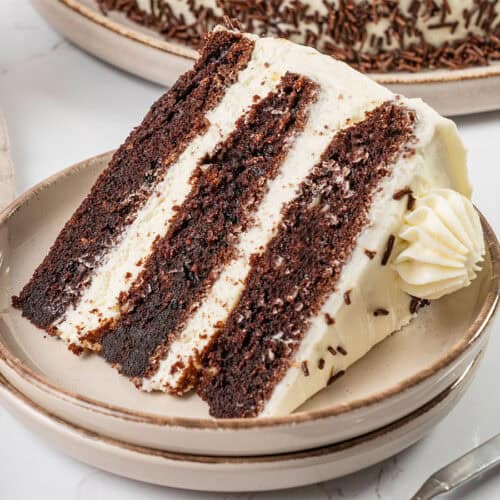
This chocolate cake with cream cheese frosting pairs three soft, deeply chocolatey sponge layers with a fluffy, tangy cream cheese frosting made without butter. The frosting is light, perfectly balanced in sweetness, and stays creamy straight from the fridge, so every slice is rich without ever feeling heavy.
This recipe has been on Spatula Desserts since 2022. Since then, I've scaled the recipe up to an 8-inch cake at your request and updated the post with new photos, helpful baking tips, and ingredient substitution options based on your questions.
Read what others said about this recipe

"This is the most wonderful recipe that looked a bit complicated at first, but then following your step-by-step instructions turned out absolutely delicious and stunning. I love chocolate and cream cheese together, and it’s not too sweet." Laura
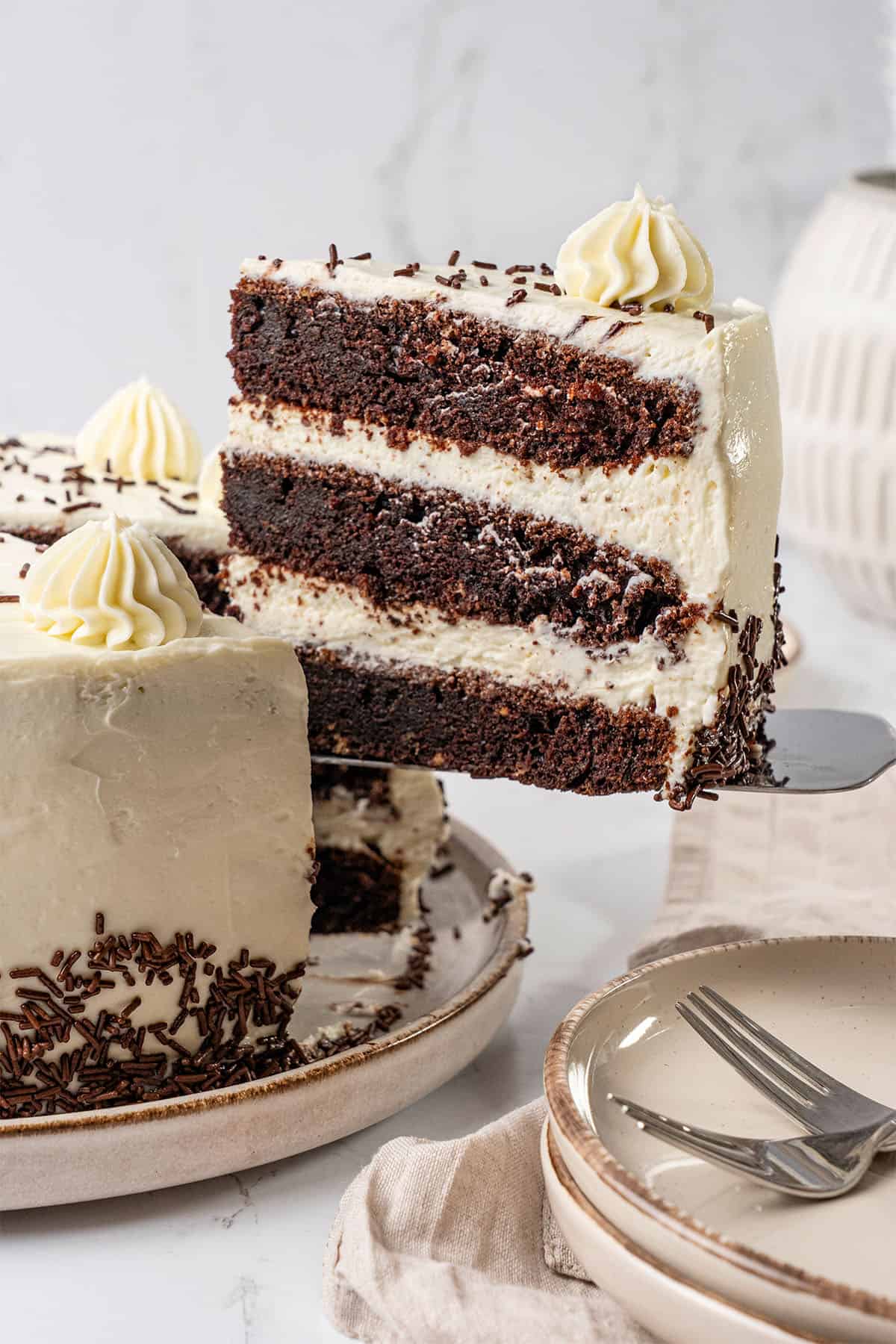
Best Chocolate Cake with Cream Cheese Frosting
Most chocolate layer cakes with cream cheese frosting follow the same formula: chocolate cake layers that need extra tricks to stay moist, and a frosting made from butter and five to seven cups of powdered sugar. Readers of these recipes regularly report cutting the sugar by half because the frosting is simply too sweet. This super moist cake has an intense chocolate flavor without being overly sweet, and it differents in two ways.
First, the sponge. It is my chocolate sponge cake, the same base I use in many of my chocolate cakes, whether it be my Nutella cake or chocolate sheet cake. Made with oil, milk, and coffee, it has incredibly moist crumbs and is the best chocolate cake recipe, with excellent ratings from readers. Stays soft even straight from the fridge, and tastes intensely of chocolate. It needs no soaking syrup, and it bakes up level.
Second, the frosting. It is my decadent cream cheese frosting without butter. Instead of relying on butter and a mountain of sugar for structure, it gets its body from high-fat dairy: full-fat cream cheese and mascarpone. That means it is fresh, tangy, and only gently sweet. It never sets hard in the fridge, and you can use the cream cheese and mascarpone straight from the fridge, with no waiting for anything to soften.
The tangy frosting and the rich chocolate sponge balance each other perfectly.
Katalin's Key Take on Why Try Cream Cheese Frosting Without Butter
A cream cheese frosting needs two things. Something to bind the water in the cream cheese, and enough fat to hold its shape. In a classic recipe, butter provides the fat and powdered sugar binds the water. Take the butter away, and most recipes compensate by adding even more sugar to stop the frosting from turning runny. It holds its shape, but it ends up cloyingly sweet, and the tangy cream cheese flavor disappears.
My frosting takes a different route. Instead of more sugar, it uses more fat: high-fat mascarpone replaces the butter, and full-fat cream cheese forms the base. The fat gives the frosting its body, so only a small amount of powdered sugar is needed. The result:
- Balanced sweetness. You taste fresh, tangy cream cheese, not just sugar, which is the perfect contrast to a rich chocolate cake.
- A light, creamy texture that stays creamy. Without butter, the frosting never sets rock-hard in the fridge, so the cake can be served cold and still taste soft.
- Quick and foolproof. Three ingredients, used straight from the fridge, and a few minutes of whipping.
The one rule is that every dairy ingredient must be high in fat. Low-fat cream cheese or mascarpone contains more water, and the frosting will turn runny no matter how carefully you whip it.
Bake the Chocolate Sponges
Measure everything by weight and make sure the eggs, milk, and coffee are at room temperature. Brush three 20 cm (8-inch) round pans lightly with oil and line them with parchment paper on the base and sides. Pans 2 inches deep are fine.
Preheat the oven to 200°C / 425°F, without the fan. The temperature always drops when you open the door, so you will lower it to the baking temperature once the pans go in.

Whisk the wet ingredients: the eggs, oil, both sugars, milk, coffee, and vanilla together for one to two minutes. Sift the all purpose flour, Dutch-process cocoa powder, baking powder, baking soda, and salt into the bowl, then fold everything together with a rubber spatula until no flour remains. Do not use the mixer at this stage, as overmixing makes the sponge tough. The batter will be very thin; that is exactly right, so do not add more flour.

Weigh the cake batter and divide it equally between the prepared pans. Place them in the oven, lower the temperature to 180°C / 356°F, and bake for 25 to 30 minutes without opening the door. The sponges are ready when a skewer ot toothpick comes out clean and the sides start to pull away from the pan.
Cool the sponges completely on a rack before handling them. Then, wrap and chill them; cold sponges are much easier to stack and frost. This sponge bakes up level and doesn't sink, but if yours does for any reason, see my guide on why cakes sink.

Whip the Cream Cheese Frosting
Place the cold high-fat cream cheese, the cold high-fat mascarpone (or very cold heavy cream), and the sifted powdered sugar in a large bowl. Start the electric mixer on low speed so the sugar does not fly everywhere. Then, whip for two to three minutes, adding the vanilla extract along the way.
Stop as soon as the frosting is fluffy and pipeable. Unlike buttercream, it does not get stiffer with longer whipping; it only gets runnier and eventually separates. If you use a stand mixer, use the whisk attachment and stay with it.
To check it, pipe a little onto a plate: it should hold its shape. If it feels soft, refrigerate it for 30 to 60 minutes before using. It firms up nicely as it chills.

Assemble and Decorate the Cake
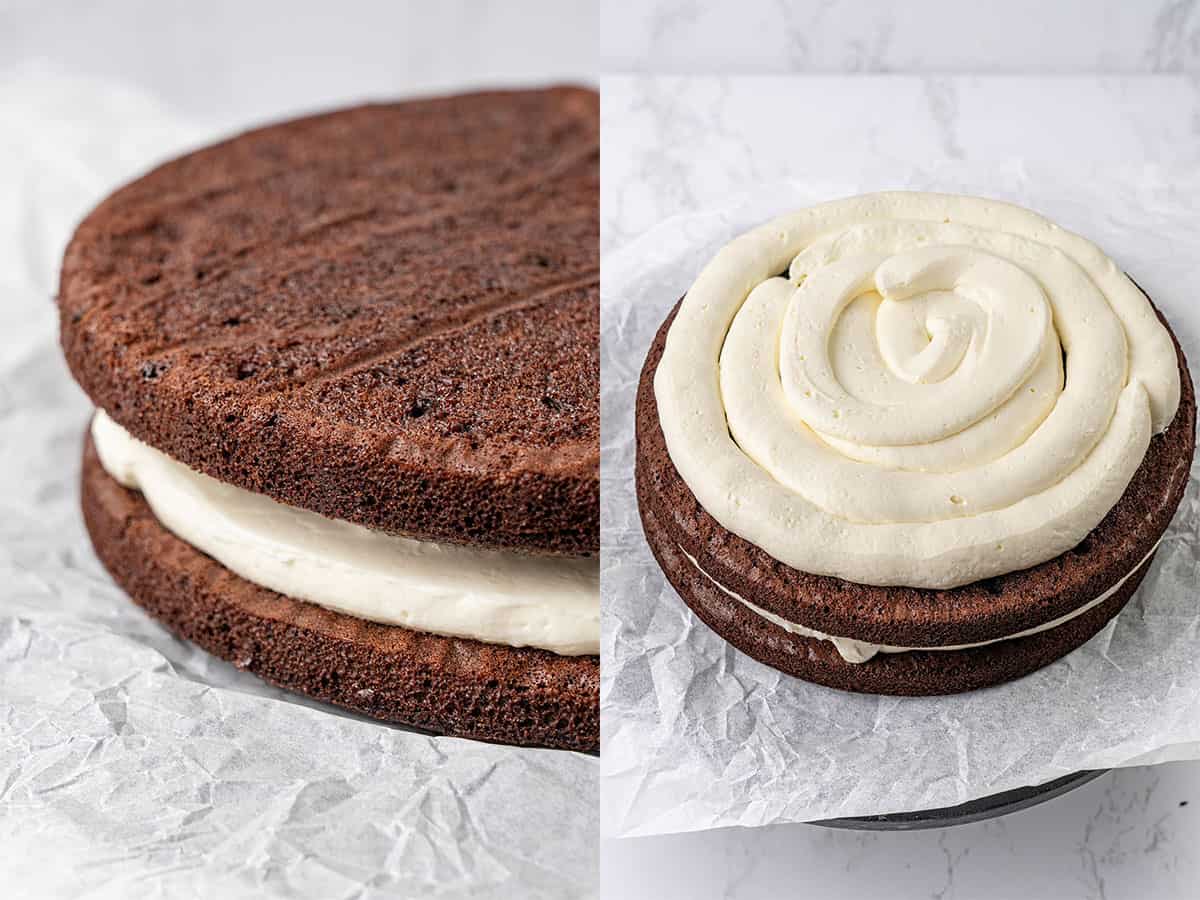
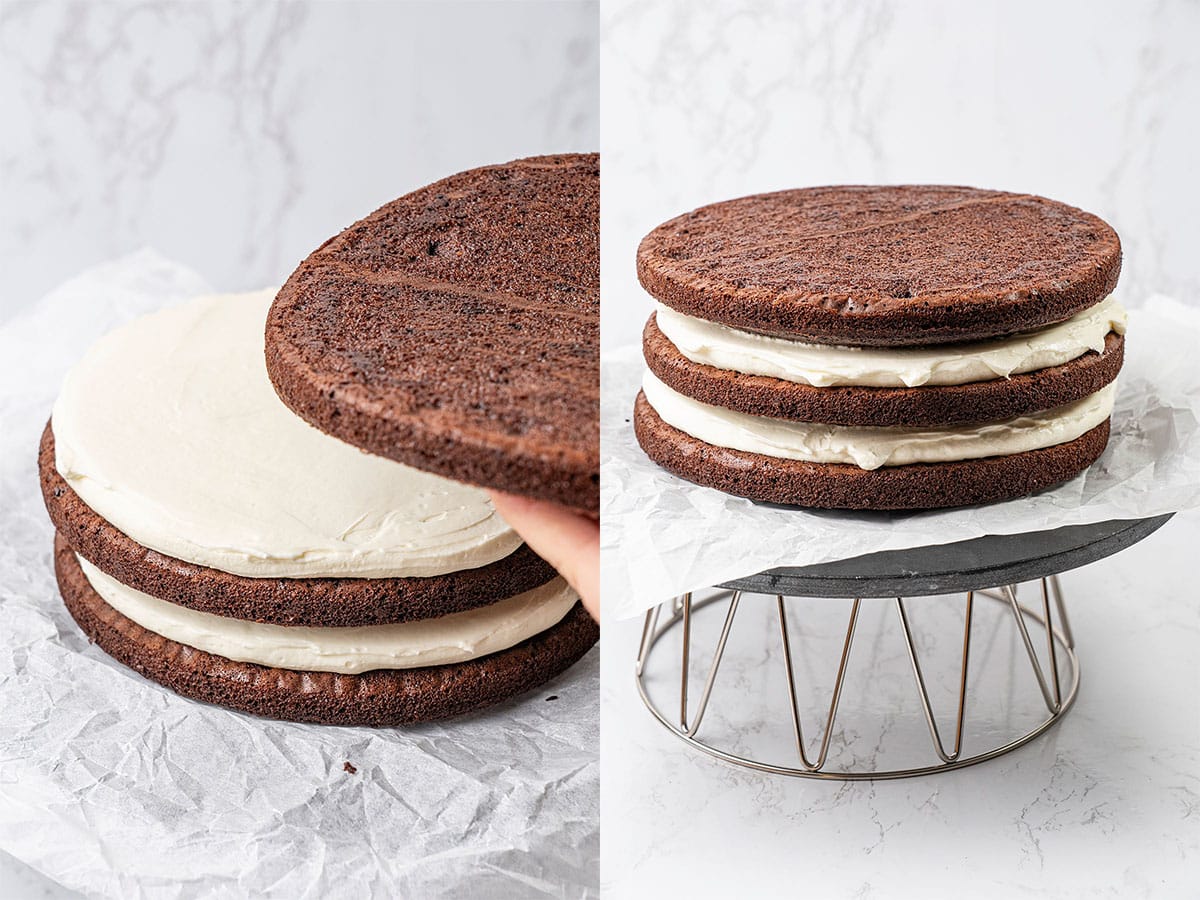
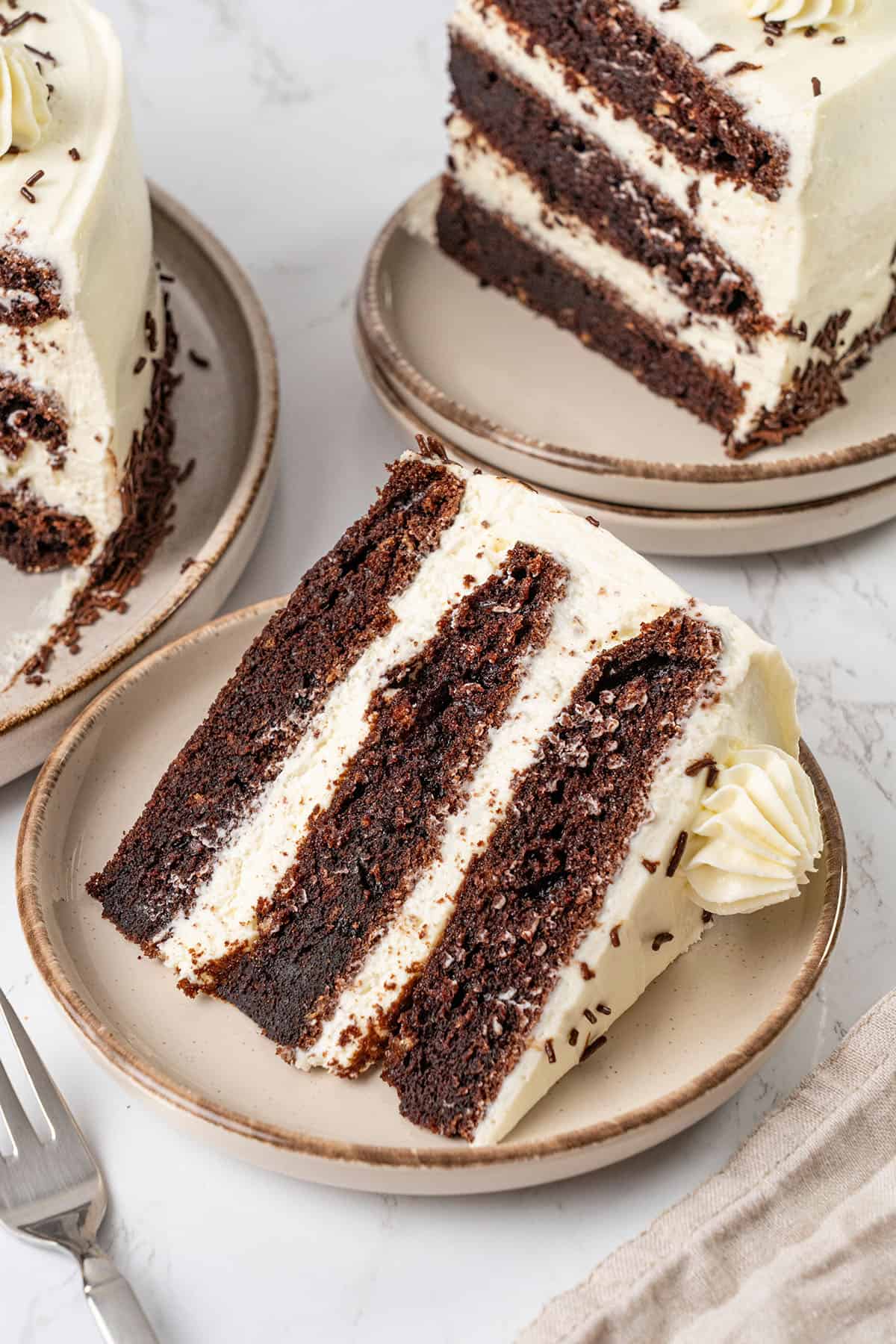
Set the first sponge directly on your serving plate or cake board. Spread an even layer of frosting on top with an offset spatula, then repeat with the second sponge and finish with the third. Check from eye level that the layers are straight and even. Chill the cake for at least 30 minutes.
Then, apply a thin crumb coat over the whole cake and chill for 30 minutes. You can stop here for a pretty semi-naked cake, but I like to finish it with a full coat of frosting, smoothed with an offset spatula on a cake turntable. Set aside some frosting for the piping decoration.
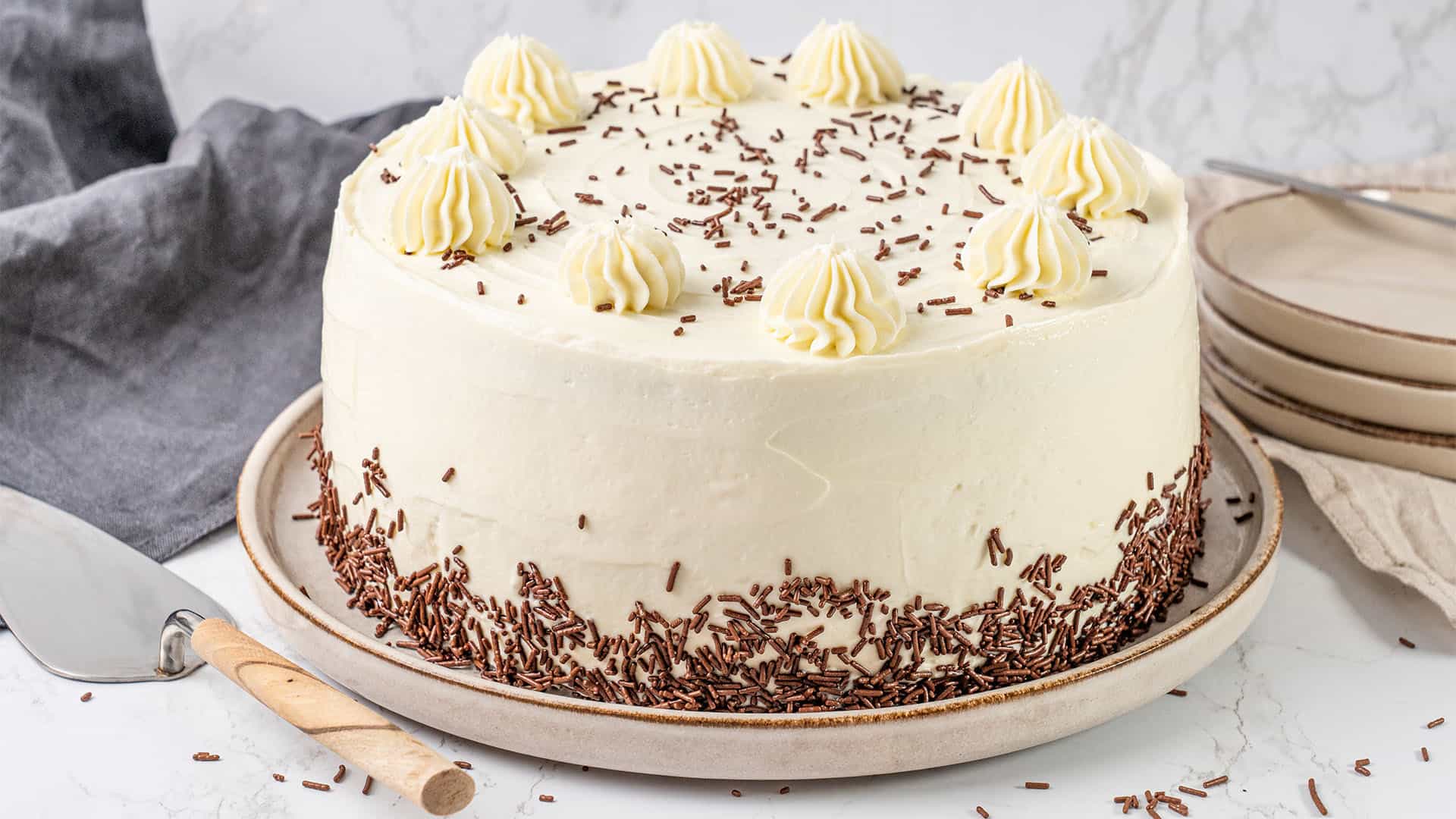
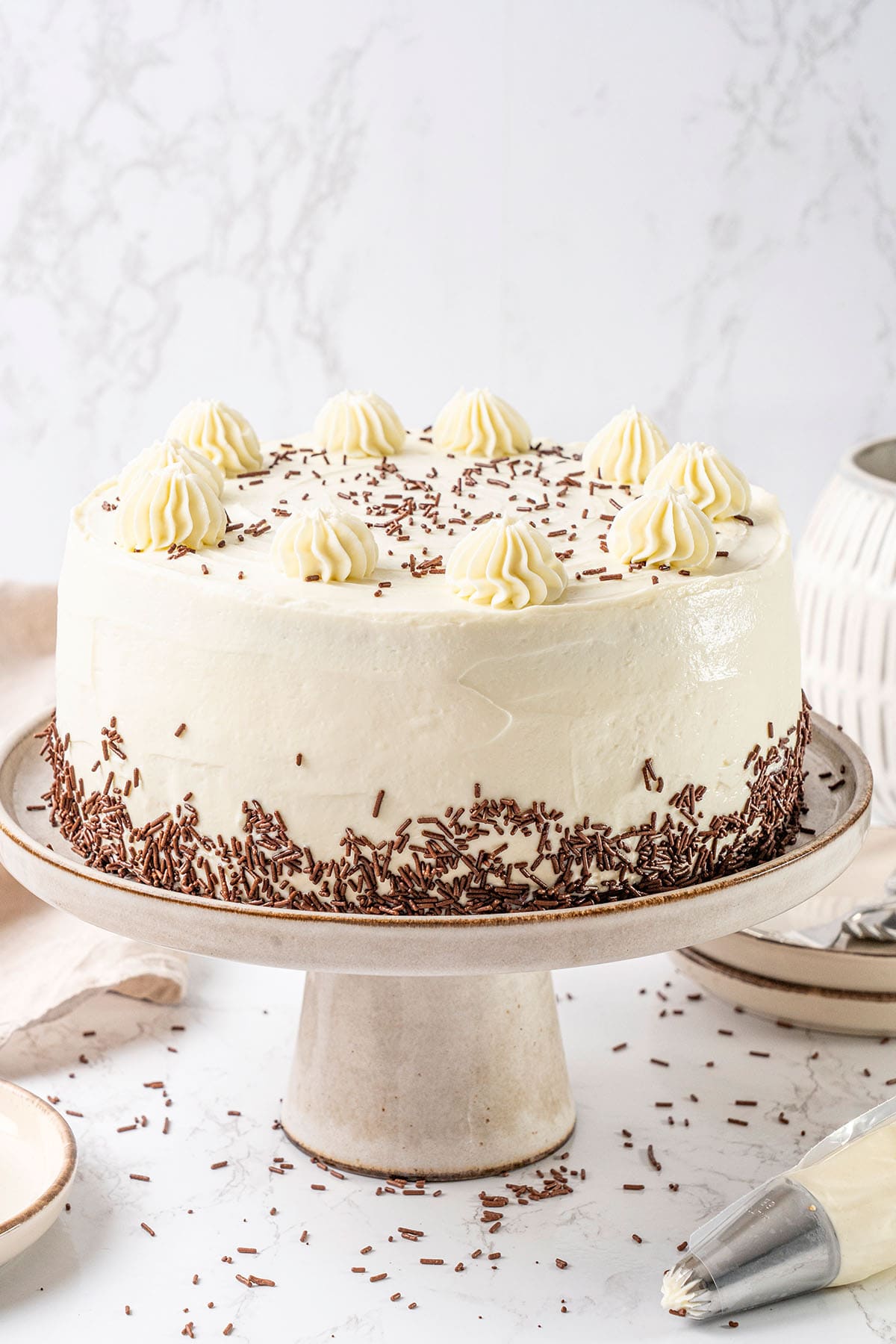
Once the cake is well chilled, press chocolate sprinkles onto the bottom and sides and scatter a few over the top and sides. Pipe the remaining frosting on top with a large round piping tip, such as a Wilton 2A, then chill the decorated cake for an hour before serving.
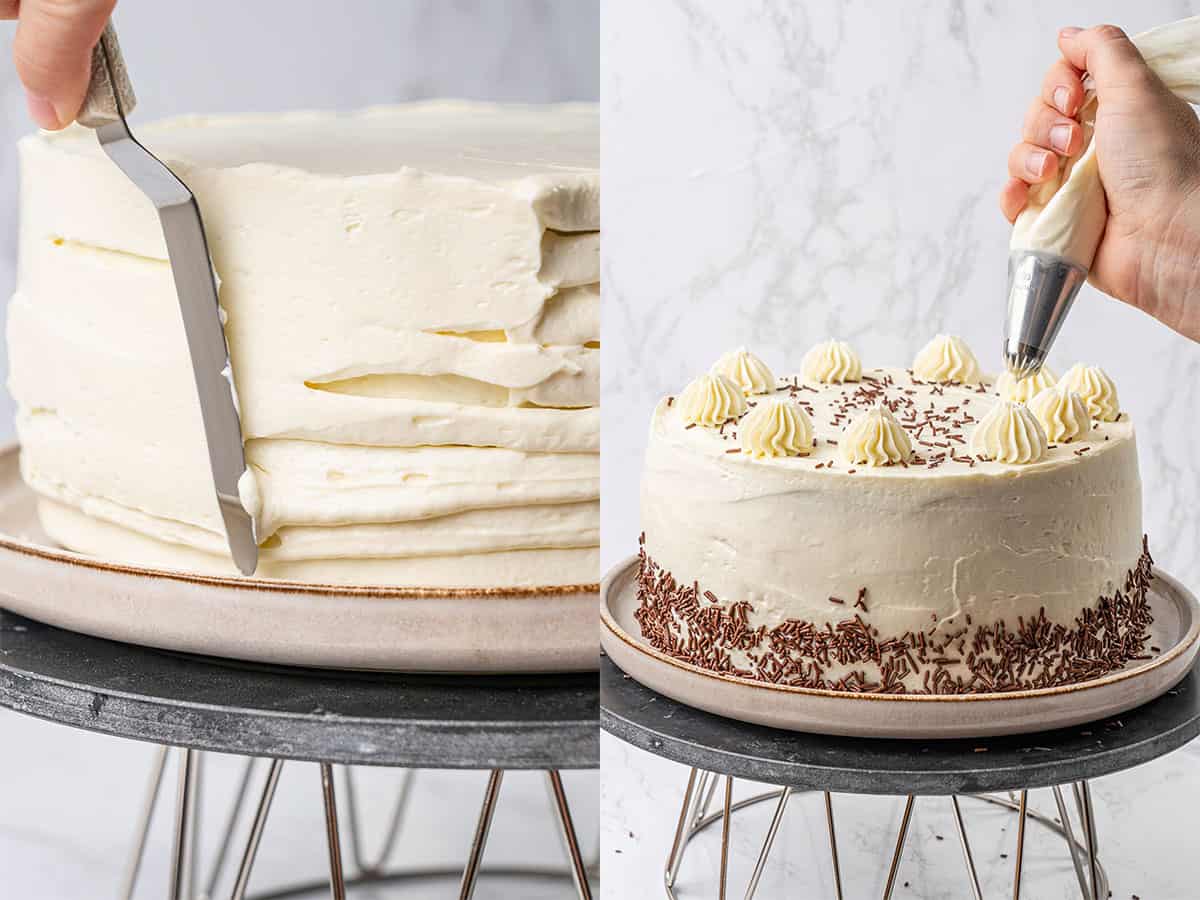
If at any point the frosting feels soft or the cake feels unstable, return it to the fridge for an hour before continuing.
Storage & Make-Ahead
Because the frosting is made with cream cheese and mascarpone, store the cake in the fridge, covered or in a cake container, for up to 3 days. The frosting does not harden when chilled, so the cake can be served straight from the fridge. Do not leave it out for more than one to two hours, and only at a comfortable room temperature of around 22°C / 71°F, never on a hot day.
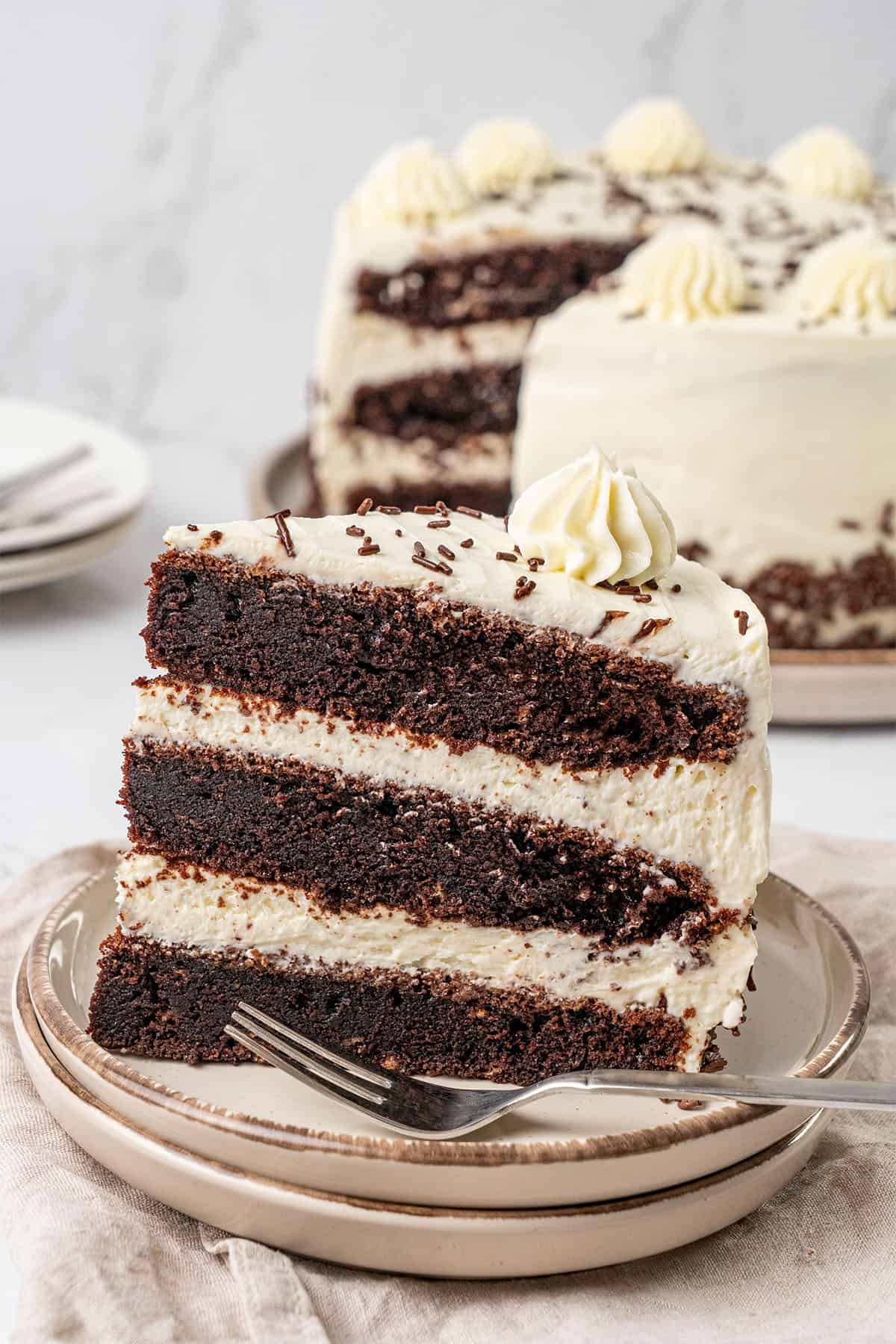
You can frost and decorate the cake the day before serving and keep it in the fridge overnight; the sponge stays soft and the frosting stays creamy. The sponges can also be baked ahead: wrap each one tightly and refrigerate for up to 5 days, or freeze for up to 3 months. I don't recommend using the freezer for the finished cake, as mascarpone doesn't freeze well.
Expert Tips
- To bring eggs to room temperature quickly, place them in a bowl of hot tap water for 5 minutes. The eggs, milk, and coffee must all be at room temperature, or the batter will not emulsify properly.
- Use freshly brewed coffee. It makes the chocolate taste deeper and richer, and you will not taste coffee in the finished cake. If you can't have coffee, replace it with the same amount of water.
- Use unsweetened, Dutch-processed cocoa powder and sift it. It gives the sponge a darker color and smoother flavor, and it reacts with the baking soda to give the cake its lift.
- Do not skip the salt. It balances the sweetness and makes the chocolate taste more chocolatey.
- Bake the batter as soon as it is mixed. The baking soda starts reacting with the coffee and cocoa right away, so letting it sit costs you lift.
- If a cake turns out dry, the usual causes are measuring flour by cup instead of weight, overmixing the batter, or overbaking. Weigh everything and check doneness early on.
- If your frosting turns runny, it was either overwhipped or made with low-fat dairy. Use full-fat ingredients, stop whipping as soon as it is fluffy, and chill it for 30 to 60 minutes to firm it up.
- If desired, add flavorings to the frosting in powder or gel form rather than liquid; start with a small amount, and never add anything warm, or the frosting will run.
- For neat piping, fill a piping bag with the frosting and refrigerate it for an hour before decorating.
Flavor Variations
The frosting is easy to flavor, as long as you add flavorings carefully. You can turn this recipe into a chocolate cake with chocolate cream cheese frosting, which may be overkill but is still delicious; mix a few tablespoons of sifted unsweetened cocoa powder into the frosting. For a mocha version, add espresso powder rather than liquid coffee.
For a fruity contrast to the chocolate, try my raspberry cream cheese frosting or strawberry cream cheese frosting. Chocolate and peanut butter lovers will adore my peanut butter cream cheese frosting.
For a fresh, zesty version, use my lemon cream cheese frosting, or add finely grated orange zest to the sponge batter for a chocolate-orange cake.
For a warm, spiced cake, add a little ground cinnamon to the dry ingredients, and a pinch to the frosting too.
Ingredient Substitutions
If you cannot find mascarpone, replace it with the same weight of very cold heavy cream with at least 36% fat. Whatever you use, every dairy ingredient in the frosting must be full-fat; low-fat versions contain more water and make the frosting runny.
For the sponge, you can replace the milk with buttermilk, oat milk, or another plant-based milk. The frosting is much harder to make dairy-free because its structure depends on the fat.
The eggs give the sponge its structure. You can try one of my egg substitutes, but expect a different texture and taste.
Any neutral oil can replace the vegetable oil; see my vegetable oil substitute guide. Replace the coffee with the same amount of water or milk, and use Dutch-processed cocoa rather than sweetened cocoa drink powder.
For any other ingredient, browse my substitute guides.
Equipment notes
A digital scale is essential for weighing the ingredients and dividing the batter evenly, and a digital oven thermometer makes sure you bake at the right temperature.
Use an electric hand mixer for the wet ingredients and the frosting, a rubber spatula for folding, and three 8-inch (20 cm) round cake pans. An offset spatula and a cake turntable make frosting much easier. A wire rack helps the sponges cool.
I use three 8-inch (20 cm) round pans; 2-inch-deep pans work perfectly. To bake the cake in a different size, scale both the sponge and the frosting by the same amount so the proportions stay the same:
For any other size, see my cake pan sizes guide.
Try Some of My Other Chocolate Cakes
If you loved this chocolate cake with cream cheese frosting, here are more cakes to try next:
Also, check out my roundup of cream cheese desserts for more inspiration.

Have you tried this recipe?
Please leave a 5-star ⭐️⭐️⭐️⭐️⭐️ rating on the recipe card and consider leaving a comment as well!
Chocolate Cake with Cream Cheese Frosting
Equipment
- 20 cm / 8 inch cake pan
Ingredients
Chocolate sponge cakes for 3 x 8 inches (20cm)
- 3 Eggs room temperature
- 110 g (½ cup) Vegetable oil
- 240 g (1 cup) Milk room temperature
- 180 g (¾ cup) Coffee freshly brewed strong coffee, room temperature
- 150 g (¾ cup) Granulated sugar
- 150 g (¾ cup) Brown sugar
- 260 g (2 cups) All purpose flour any low protein content flour eg. pastry flour can work too.
- 75 g (¾ cup) Cocoa powder unsweetened, dutch processed
- 1½ teaspoon Baking soda
- 1½ teaspoon Baking powder
- ½ teaspoon Salt
Cream cheese frosting
- 900 g (4 cups) Cream cheese full fat eg. Philadelphia
- 340 g (1½ cups) Mascarpone full fat
- 180 g (1½ cups) Powdered sugar sifted
- 3 teaspoons Vanilla extract
US customary cup measurement is an indicative figure only. Measure the ingredients with a digital scale by weight (gram). Baking is art but also science which requires precision and accuracy.
Instructions
For the chocolate sponge layers
- Preheat the oven to 200°C / 425°F (no fan). Line 3 x 20 cm (8-inch) pans with parchment paper on the base and sides.
- Whisk the room-temperature eggs, oil, both sugars, milk, coffee, and vanilla with an electric mixer for 1 to 2 minutes.
- Sift in the flour, cocoa powder, baking powder, baking soda, and salt, and fold with a rubber spatula just until combined.
- Weigh the batter equally into the 3 pans. Place them in the oven, lower the temperature to 180°C / 356°F, and bake for 25-30 minutes, until a skewer comes out clean and the sides pull away from the pan.
- Cool completely on a rack, then wrap and chill the sponges before assembling.
For the cream cheese frosting
- Place the cold cream cheese, cold mascarpone, and sifted powdered sugar in a bowl. Whip with an electric hand mixer, starting on low speed, for 2 to 3 minutes, adding the vanilla, until fluffy and pipeable. Stop right there; over-whipping makes it runny.
- Chill for 30 to 60 minutes if it feels a bit soft.
Assemble the cake
- Measure the frosting: you will need about 300g between the layers, about 350g to crumb-coat, and about 400g to frost and decorate.
- Place the first sponge on your serving plate and spread an even layer of frosting on top. Repeat with the second sponge, then top with the third.
- Chill for at least 30 minutes until firm. Apply a thin crumb coat and chill for 30 minutes. Finish with a full coat of frosting, or leave it semi-naked. Keep some frosting for piping.
- Press chocolate sprinkles onto the bottom and sides, and scatter a few over the top and sides. Pipe the remaining frosting on top with a large round tip. Chill for 1 hour before serving.
- Store in the fridge for up to 3 days and serve straight from the fridge.
Notes
- Measure your ingredients with a Digital scale for accuracy.
- All ingredients for the chocolate cake must be at room temperature to properly emulsify: eggs, milk, coffee, etc.
- The coffee deepens the chocolate flavor without tasting like coffee. Replace it with water or milk if needed.
- For the frosting, use mascarpone and Philadelphia full-fat versions
- Do not overbake your sponge layers, as that will result in a dry texture. Use the toothpick test to check if your cake is ready.
- Cool the cake completely on a wire rack. This helps the cake stay intact as it cools and comes out of the pan.
- When whipping the frosting, pay attention to the consistency and stop as soon as it is fluffy and pipeable. This will take only a few minutes.
- During assembly, if at any point the frosting feels soft or the cake feels unstable, place it in the fridge for 1 h to chill, then continue with the next layer.
Rachel
This recipe looks amazing, I’m excited to try it out for my dads birthday. Thanks for all the notes and suggestions. Do the tins need to be 3” deep or is 2” ok?
Kata
Probably 2inch will be fine. Let me know how it turns out:)
Laura
This is the most wonderful recipe that looked a bit complicated at first but then following your step by step instructions turned out absolutely delicious and stunning. I love chocolate and cream cheese together and it’s not too sweet.