
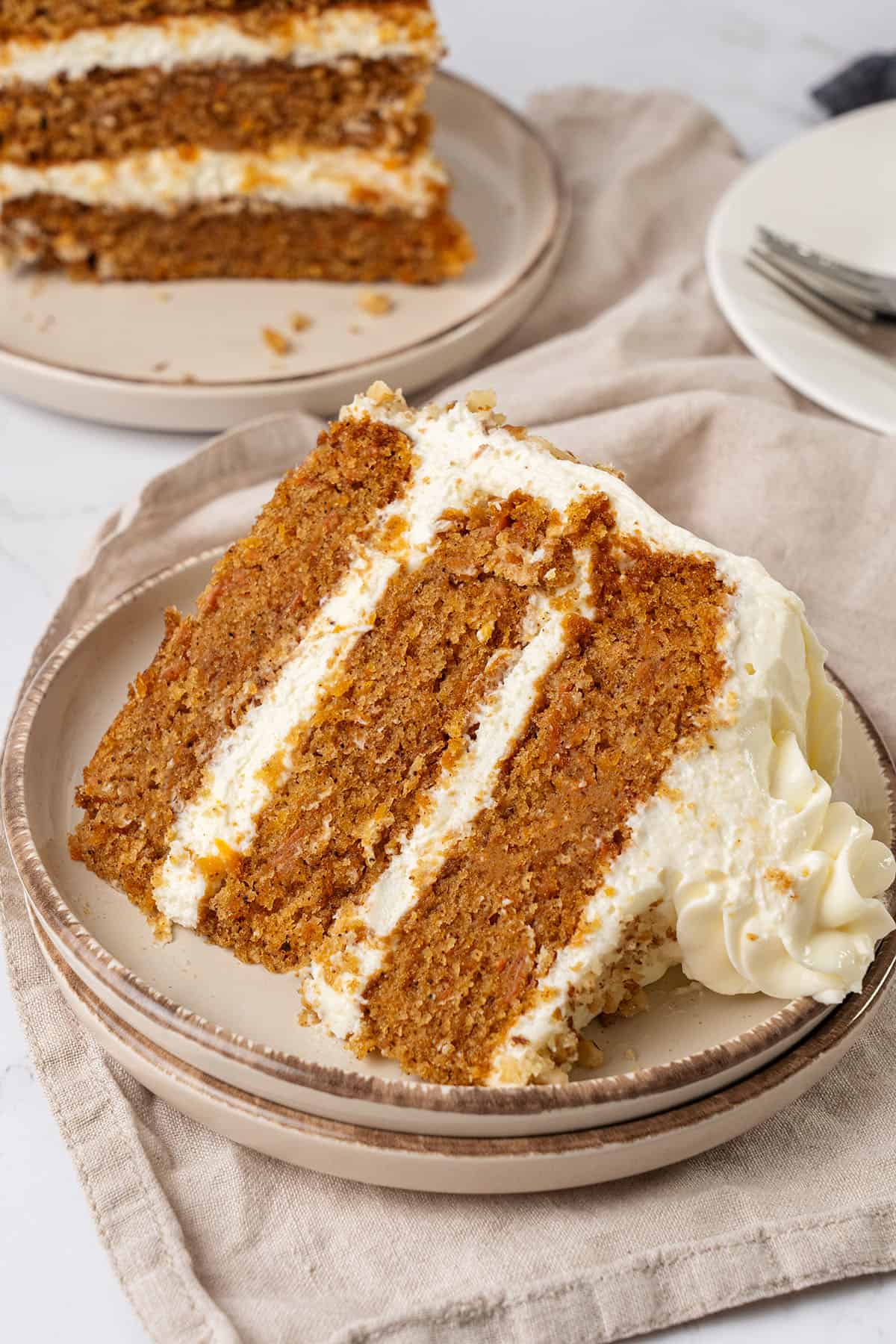
This layered carrot cake recipe is everything a classic carrot cake should be: ultra-moist, perfectly spiced, and layered with a silky cream cheese-mascarpone frosting. Loaded with freshly shredded carrots, every bite is tender and flavorful, and the homemade frosting perfectly balances the rich cake layers. You'll love making this bakery-style dessert that feels both comforting and elegant.
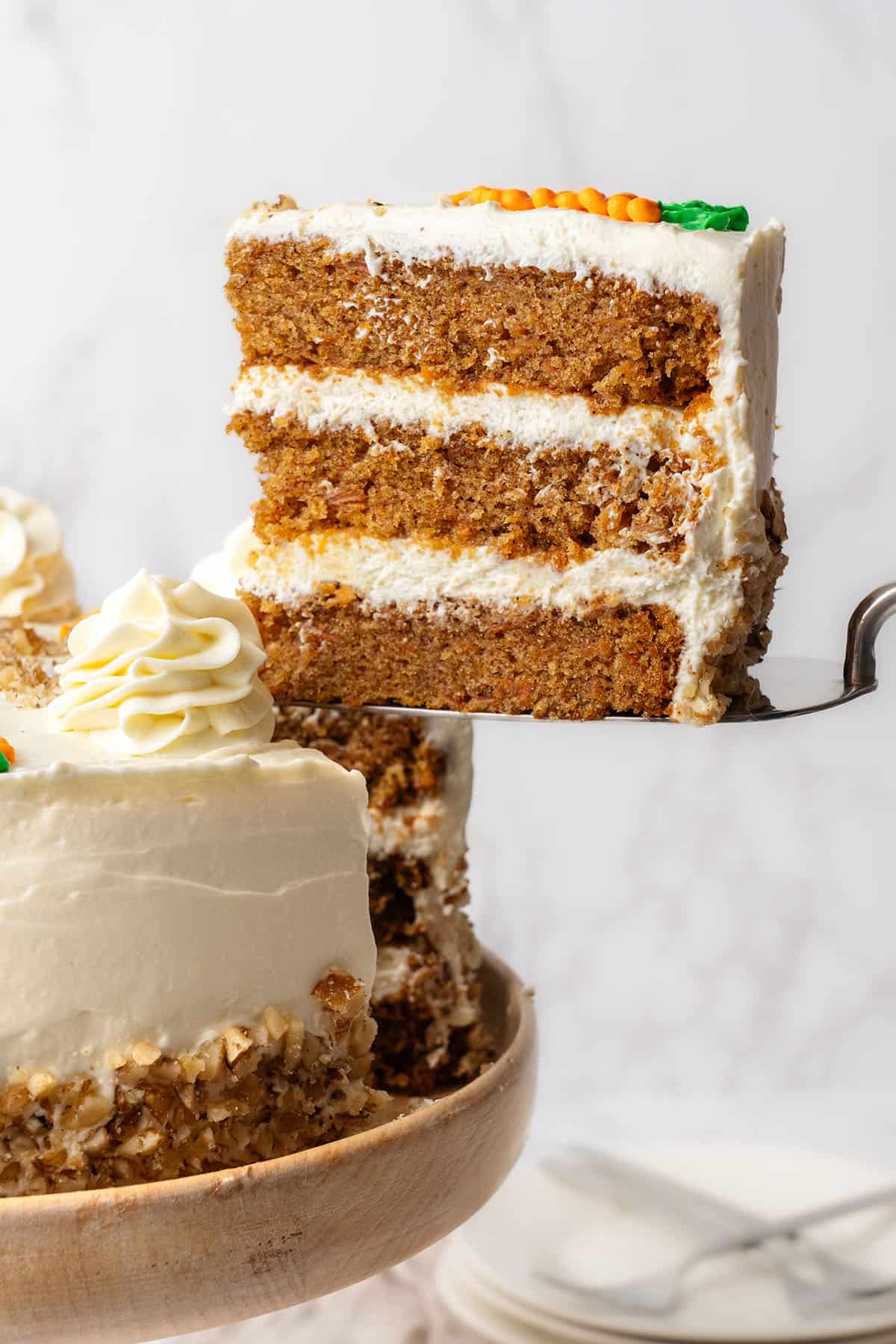
What you can expect from making this Carrot Cake
Don't let the layers of this homemade carrot cake fool you. It's actually an easy dessert that even beginner bakers can make!
You'll find a lot of carrot cake recipes skip steps by using cake mixes as the base, but that's not something that happens in my kitchen. I believe in making desserts from scratch and testing them all 100% before sharing them with you. I can tell you, with confidence, that this carrot cake recipe is ready to bake and enjoy, even for beginners!
One thing that I think is super important for carrot cake is that it has to be moist, and not dry. I've found that using oil instead of butter is exactly what gives the perfect texture. Also, shredding your own carrots is a must, and I dive into that a bit more below. And I don’t mess around with frosting either. This extra-light, airy, not-too-sweet cream cheese frosting — made without butter but with mascarpone — stays soft and silky, even straight from the fridge, and perfectly complements the moist carrot cake layers.
Katalin's key take on how to make carrot cakes extra moist
The secret to extra-moist carrot cake lies in both the ingredients and the way the batter is mixed. One of the biggest game changers is using oil instead of butter. Since oil is liquid at room temperature and even after chilling, it creates a softer, moister crumb that stays tender rather than dry.
The combination of granulated sugar and brown sugar also plays an important role, as the molasses in brown sugar adds additional moisture and depth of flavor. I love varying sugar in baking, so be sure to read my sugar guide for all my top tips.
Freshly shredded carrots are another key factor. Avoid pre-shredded carrots from the store, which are often too dry and thick for baking. Fresh carrots release moisture into the batter while baking, helping create that incredibly soft texture carrot cake is known for.
Technique matters just as much as the ingredient choices. Overmixing the batter (especially when folding in the dry ingredients) can develop too much gluten, leading to a heavier texture. Overbaking is another mistake that can quickly dry out carrot cake, so it is best to start checking the layers a few minutes early.
Make the carrot sponges
Before you get started, be sure that your eggs are at room temperature. If they're too cold, they won't emulsify, which will throw off the cake's texture.
Preheat your oven to 350°F (175°C) and grease three 8-inch (20cm) round cake pans. To keep the pan clean, line it with parchment paper before adding the cake batter. You'll need to do these steps for all three cake pans.
Use a hand mixer to lightly whip the oil, room-temperature eggs, granulated and brown sugars for a couple of minutes, until well combined.

Sift in the all purpose flour, baking powder, baking soda, cinnamon, and salt. Fold into the wet ingredients. Lastly, fold the shredded carrot into the batter just until combined. (If you need to shred the carrots quickly, use a food processor with a shredding disc. Game changer!)

Divide the batter among the 3 8-inch (20cm) round cake pans. Best, if using a digital scale, so each pan has an equal amount of batter.
Then, bake the sponge layers at 350°F (175°C) for about 20-25 minutes. The easiest way to test the cake's doneness is to insert a toothpick into the center and remove it. If it's clean and clear of batter, the cake is done baking and ready to be removed from the oven.
The baked cake needs to cool completely at this point. Don't rush this part. It's essential that it be cooled so the frosting doesn't melt on the sponge layers.
Make the cream cheese frosting
You're going to love how easy this vanilla cream cheese frosting is to make. However, make sure all dairy ingredients (cream cheese, heavy cream) are high-fat and very cold before use.
Whip the cold cream cheese and mascarpone, vanilla extract, and sifted powdered sugar with an electric mixer. Once you notice the texture getting thicker and forming peaks, stop mixing. If you overmix past this point, the frosting will actually break down and become a runny, thin mess.

If you're unable to use the frosting right away because the cakes are still cooling, place the frosting mixture in the fridge until it's time to use it. Keep it cold!

Assembling the cake
After the cakes have cooled to room temperature, it's time to decorate.
Before getting started, it's important to note that you will need to set aside a bit of frosting to decorate the top of the cake at the end of assembling. So be sure to factor that in as you're using it on the cake layers.
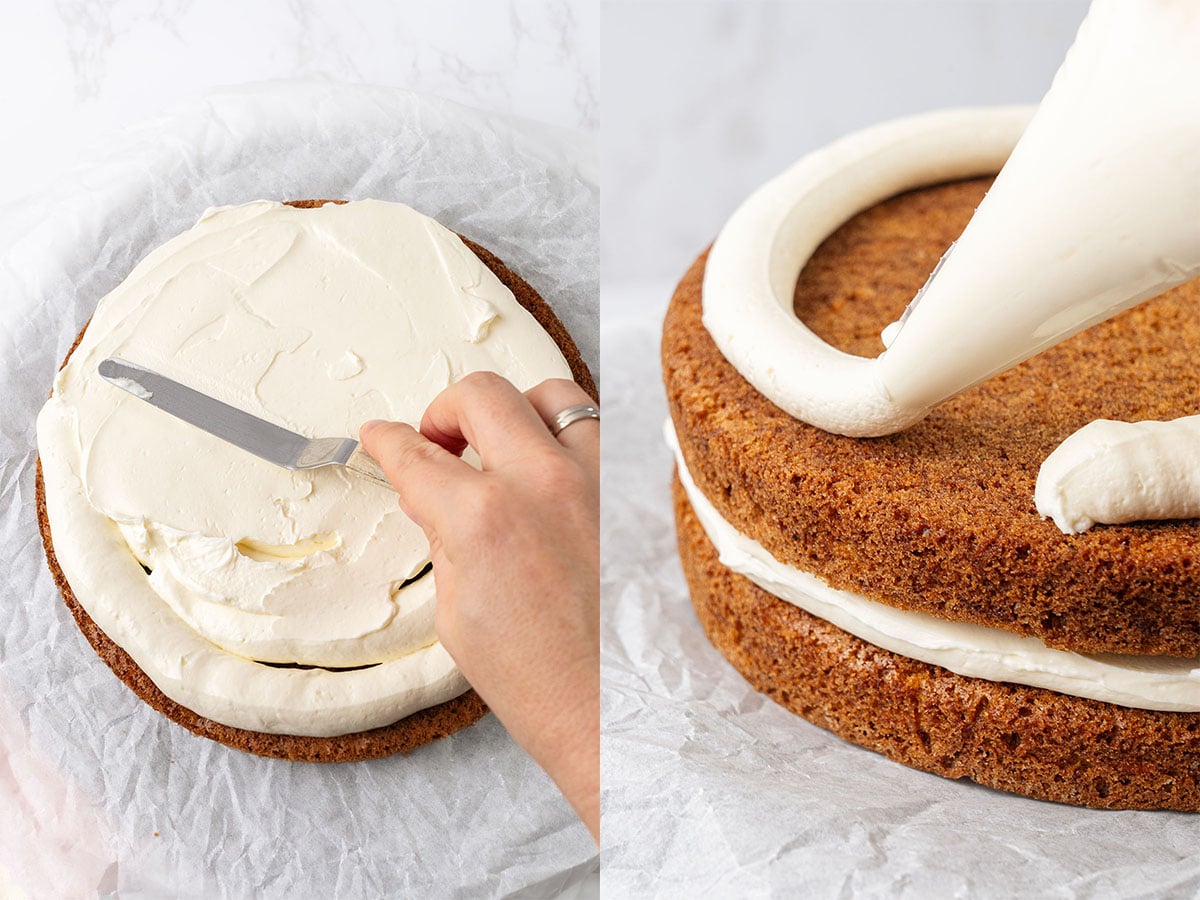
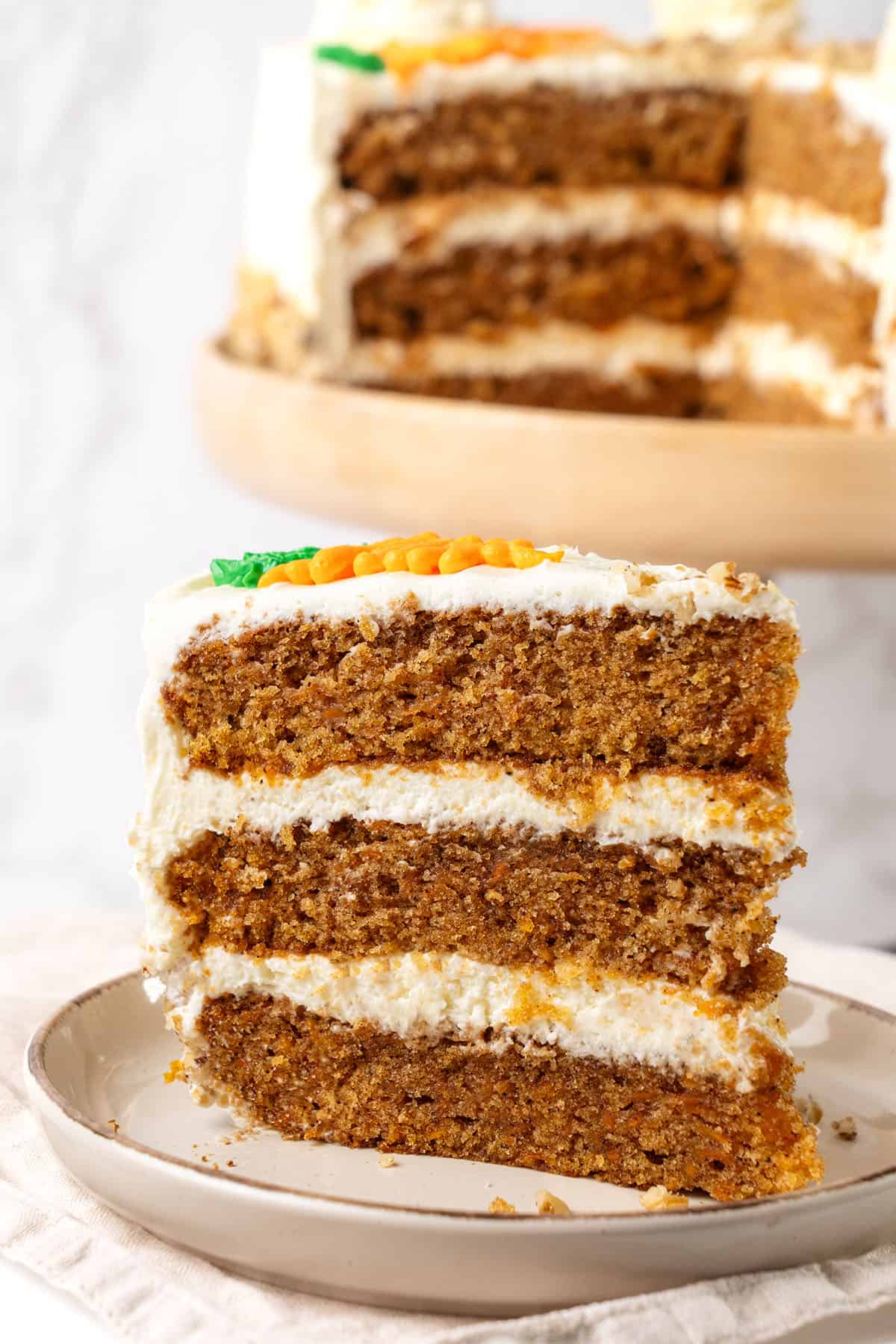
Put the first cooled cake onto your cake board, then spread some frosting over the top. Then, add the second cake layer and repeat with another layer of frosting. I like to use an offset rubber spatula to spread the frosting, as it's a quick way to evenly coat the cake surfaces. If you want to be precise, weigh the frosting so both layers are equal. I used 300g + 300g, so a total of 600g.
Then, add the third later, and repeat. Make sure you stack them as evenly as possible so the cake doesn't lean or fall. Place the cake in the fridge to chill for 1 hour so that the frosting sets.
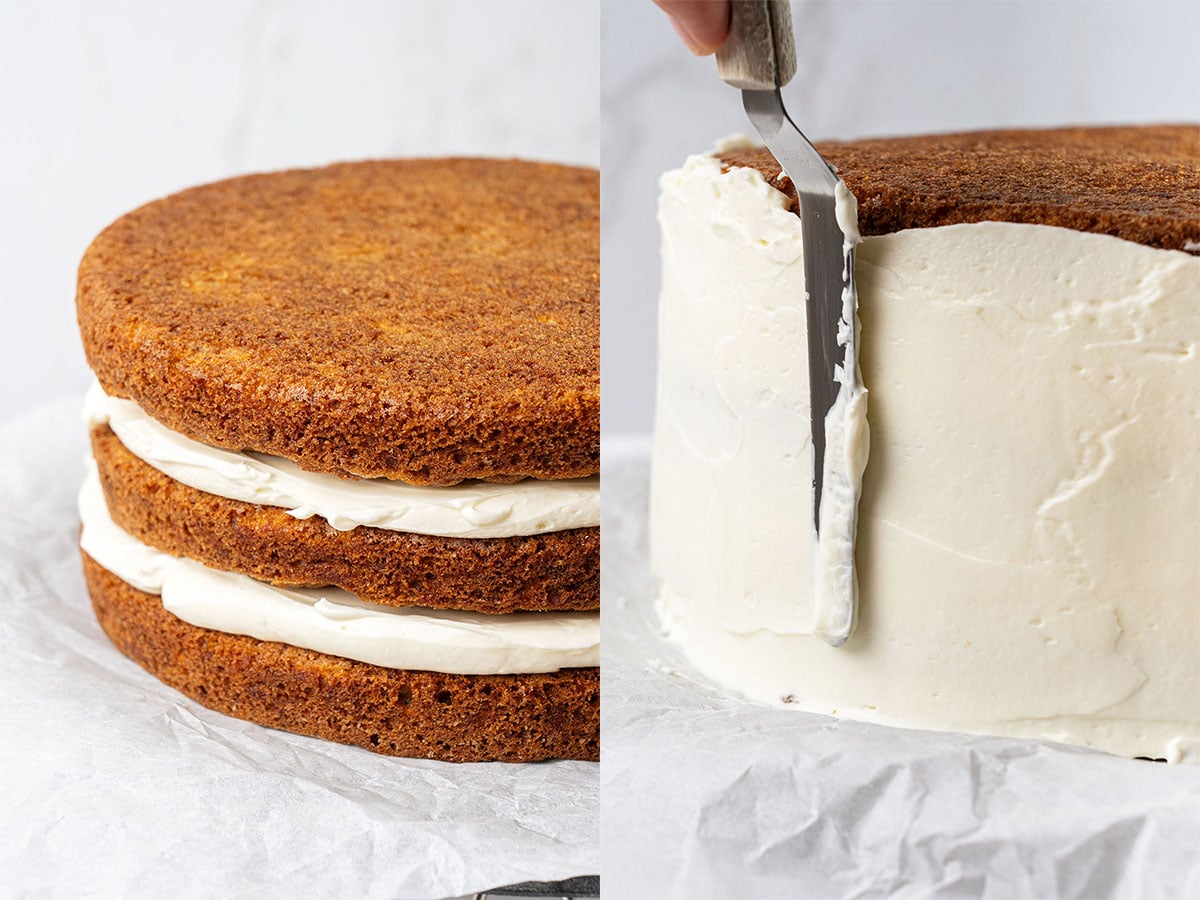
After the cake has chilled, it's time to add a crumb coat. That's just a fancy way of saying to frost the sides and top of the entire cake. It traps loose crumbs, hence the name. Again, I am using 300g frosting for the crumb coat. Once done, place the cake back in the fridge to chill for 1 hour.
Then, finish with the final layer of frosting and smooth with an offset spatula or cake smoother.
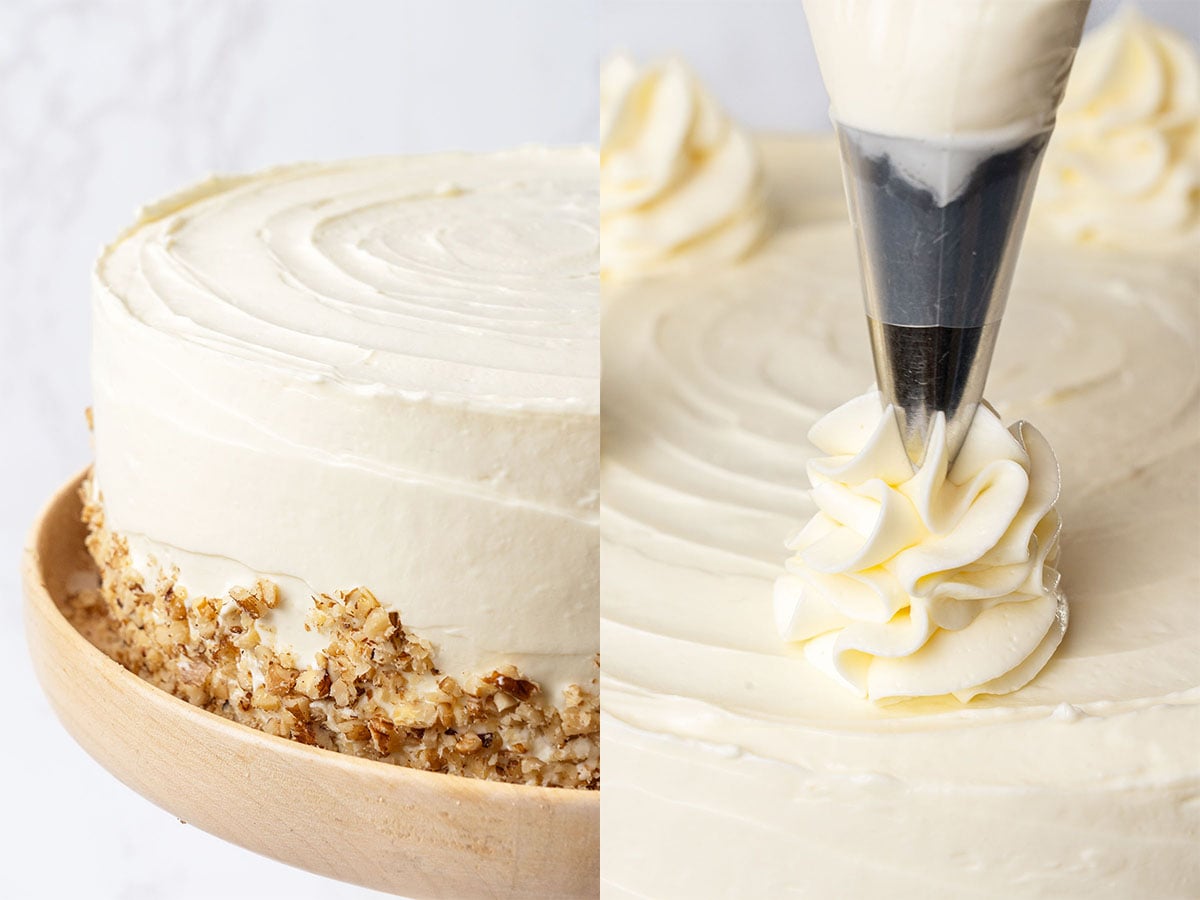
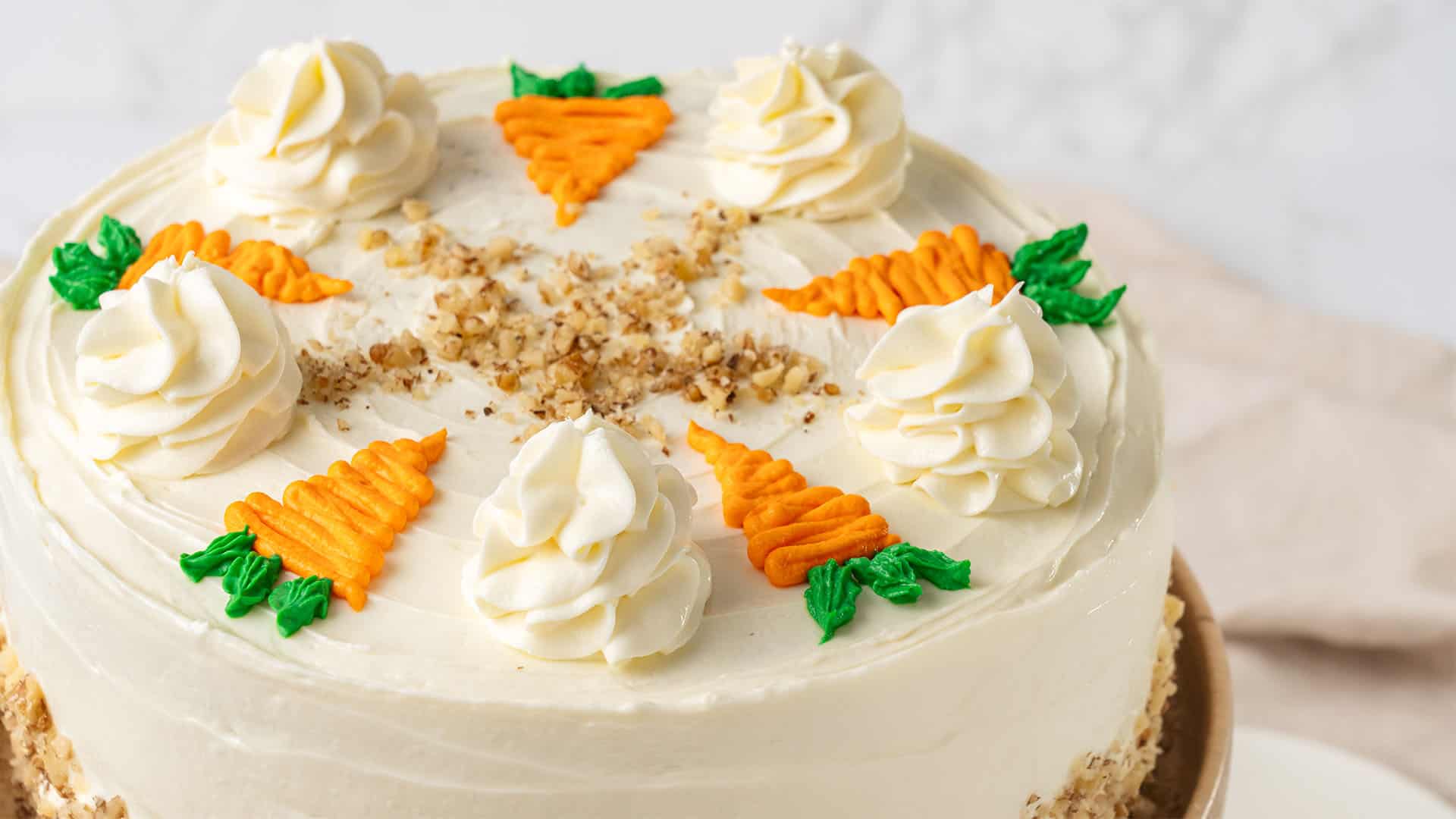
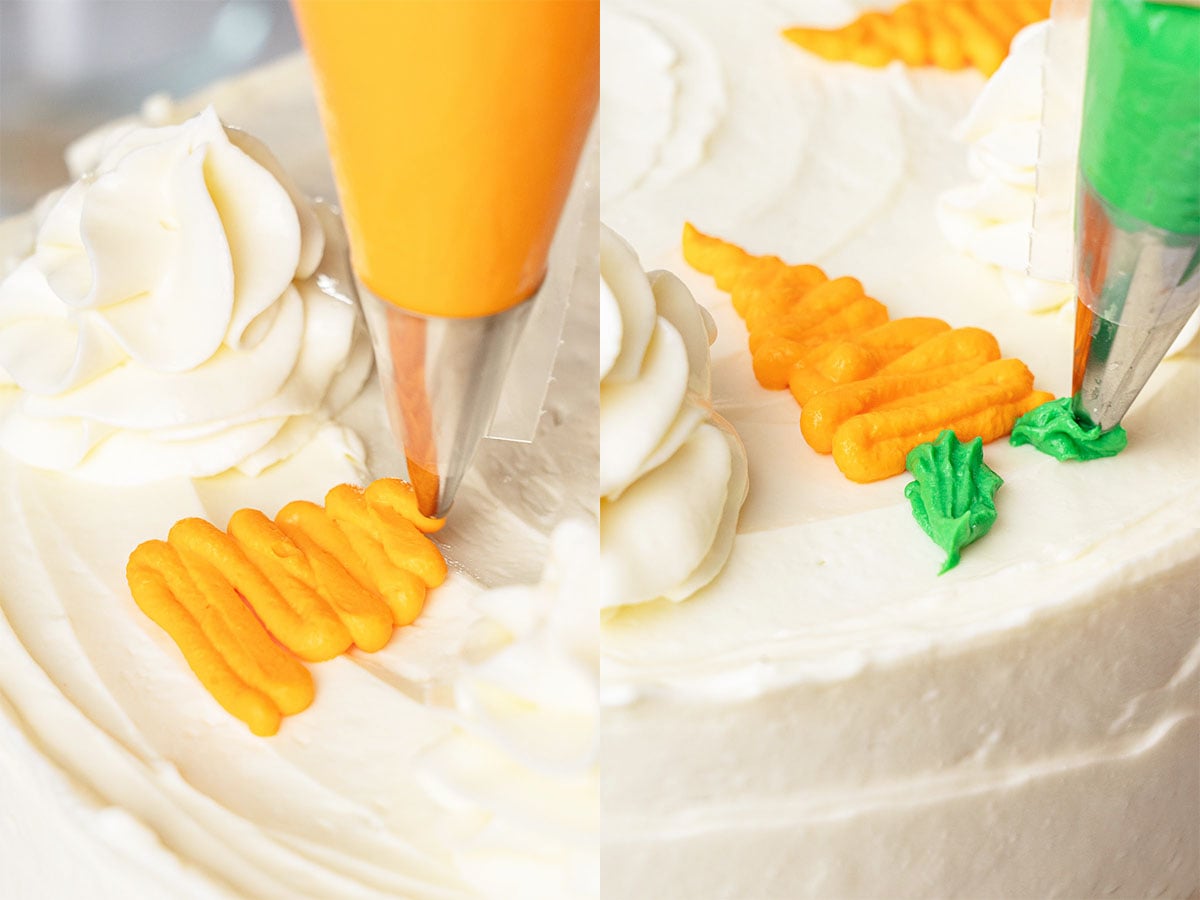
Then, continue with the decoration. Add a bit of green to a little of the frosting and a bit of orange to the rest. Put the two different-colored frostings into two separate piping bags with small round nozzles. (If you don't have nozzles, you can just use a plastic bag to add the frosting into and then just clip off the end of the bag so there is a small hole.)
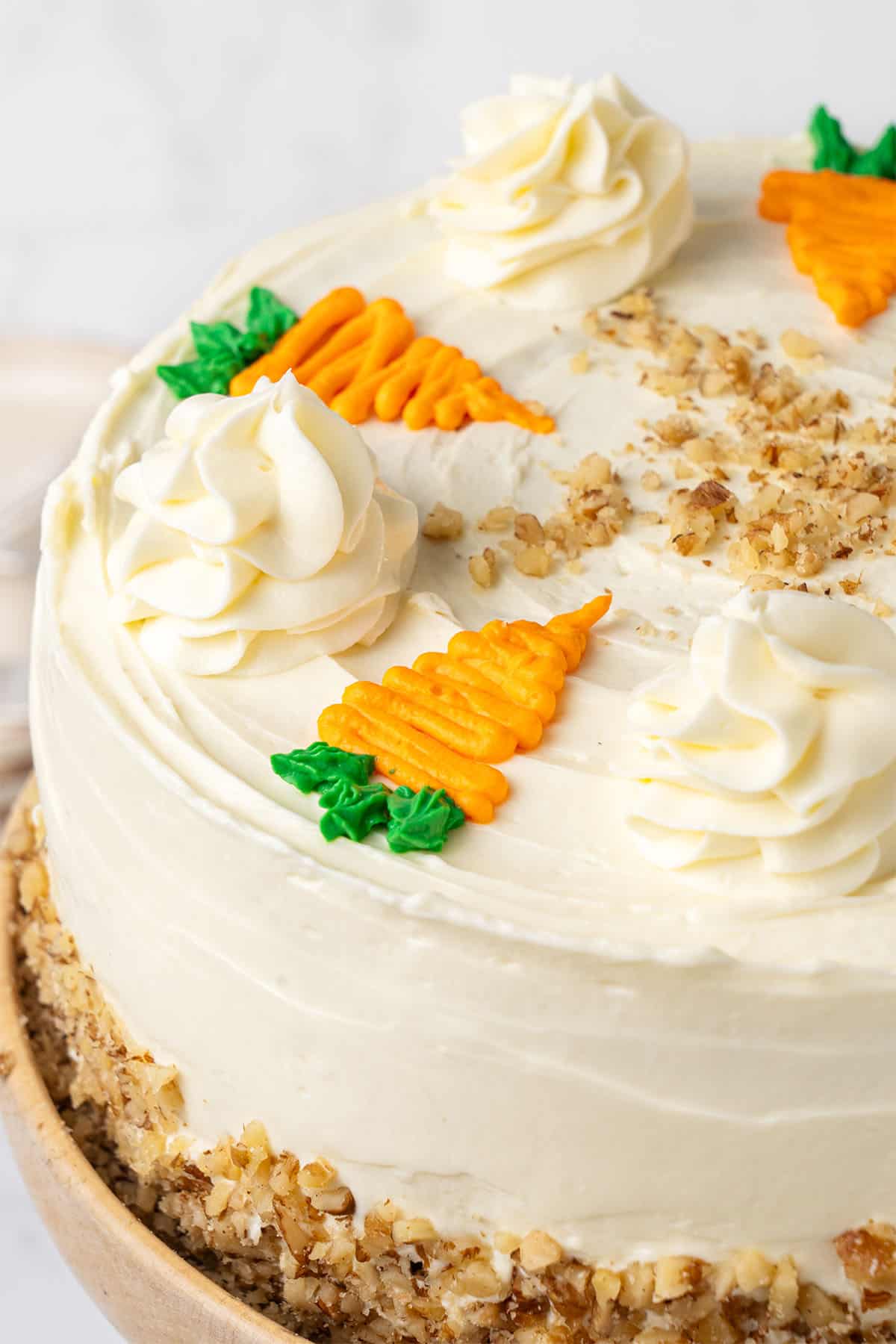
Pipe the carrot shapes to the best of your creative ability. Have fun! It's your edible work of art. To complete, add chopped walnuts on top and around the edges, and you're done.
Storing: fridge vs freezer
For the best flavor and texture, enjoy the carrot cake the day it's baked. If you can't quite bring yourself to eat the entire cake, just store the leftovers in an airtight container in the fridge for 2-3 days.
A lot of people want to freeze this cake for later, but I don't recommend freezing desserts like this one that use cream cheese. The temperature change makes the texture become grainy, and it's just not the same.
However, you can absolutely freeze the sponge layers on their own. Just wrap them tightly and thaw before frosting and assembling the cake.
Make-ahead instructions
You can easily make the sponge cake layers ahead of time, which is great if you need to prep and assemble later or just need to bake in spurts.
Once the cake layers have cooled, wrap each layer individually in plastic wrap and store them in the refrigerator for up to 2 days. You can also freeze them for up to 2 months.
If you need to prep the cream cheese ahead of time, you can do so 1 day before you plan to use it, but be sure to keep it in the fridge. Keep it in a sealed container as well, so it doesn't absorb flavors from other foods in the fridge.
Flavor variation ideas
Here are a few options to change the flavor of this traditional carrot cake recipe:
Use a different frosting: My cream cheese frosting recipe is a great option, or you can use any flavor or type you like.
Toppings: Some people want to have different nuts, shredded coconut, or even a few raisins on top of the cake. Add to your liking and enjoy.
Seasonings: Have fun during different times of the year by trying different flavors. Pumpkin pie spice would be super good during fall!
Some potential ingredient substitutes
Need some options instead of oil? Here is a useful guide on how to substitute oil in cakes. Butter is a great place to start.
Want to substitute the eggs? It is not the best idea unless the recipe is completely re-formulated. Check out these egg substitutes for options.
Nut allergy? This carrot cake contains no nuts, expect the decoration that can be easily skipped.
Regarding the dairy products in the frosting, you can try to substitute them with vegan alternatives, however, expect the flavor to turn out slightly different.
My expert tips
- Shred your own carrots instead of pre-shredded packaged carrots. Store-bought shredded carrots are usually thicker, drier, and coated to prevent sticking, which affects the cake's texture and moisture.
- Bring the eggs to room temperature before mixing the batter. Room temperature eggs blend more evenly into the oil and sugar mixture, helping create a smoother batter and a softer final texture. If your eggs are cold when you are ready to start baking, place them in a bowl of warm water for 5-10 minutes, and that should do the trick.
- Use an oven thermometer if possible. Many home ovens run hotter or cooler than the displayed temperature, and a small temperature difference will affect how evenly the carrot cake bakes.
- Avoid opening the oven door too early while baking. Sudden temperature changes can cause the cake layers to sink in the center before they are fully set.
- For clean cake slices, refrigerate the assembled cake for at least a few hours before serving, then wipe the knife clean between each cut. This helps preserve the beautiful layers and keeps the frosting neat.
Helpful equipment
A digital scale is a must when baking to ensure you have the most precise measurements. A digital oven thermometer also makes sure that you are baking your cake at the right temperature.
Using an electric hand mixer to mix the ingredients and a rubber spatula to fold and scrape the bowl are two of my top picks.
To bake and decorate the cake, you'll need an 8-inch round pan, an offset spatula to add and spread the frosting evenly, and two piping bags with round-tipped nozzles to make those cute carrot designs.
Thinking that you should make this carrot cake in a different size? You can try my Carrot Sheet Cake, these Mini Carrot Cakes, or check out my cake pan conversion guide for other options.
Try some of my other layered cake recipes
If you're a fan of layered cakes, here are some other delicious homemade recipes to try:
- Chocolate cake with cream cheese frosting
- Victoria sponge cake
- Strawberry Icebox Cake
- Chocolate Eclair Cake
- Lemon Icebox Cake
Have you tried this recipe?
Please leave a 5-star ⭐️⭐️⭐️⭐️⭐️ rating on the recipe card and consider leaving a comment as well!
Carrot Cake
Equipment
- 20 cm / 8 inch cake pan
Ingredients
Carrot cake sponges
- 290 g (1⅓ cups) Vegetable oil
- 200 g (1 cup) Granulated sugar
- 150 g (⅔ cup) Brown sugar
- 4 Egg at room temperature
- 330 g (2⅔ cups) All purpose sifted
- 1¼ teaspoon Baking powder
- 1¼ teaspoon Baking soda
- 3 teaspoon Cinnamon
- 1 teaspoon Salt
- 300 g (1½ cups) Carrot peeled and freshly shredded
Cream Cheese Frosting
- 900 g (4 cups) Cream cheese full fat (33%+) e.g. Philadelphia, use it cold
- 340 g (1½ cups) Mascarpone full fat (41%+), use it cold
- 180 g (1½ cups) Powdered sugar sifted
- 1½ teaspoon Vanilla extract
Decoration
- orange and green gel food coloring for the carrot piped pattern
- 55 g (½ cup) chopped walnuts
US customary cup measurement is an indicative figure only. Measure the ingredients with a digital scale by weight (gram). Baking is art but also science which requires precision and accuracy.
Instructions
Make the carrot cake sponges
- Preheat the oven to 175°C (350°F). Grease a 20 cm (8-inch) round cake pan or line it with parchment paper for easier removal.
- Using an electric hand mixer, whip the room temperature eggs, oil, granulated sugar, and brown sugar together for 1-2 minutes until smooth and well combined.
- Sift the dry ingredients—flour, baking powder, baking soda, cinnamon, and salt—into the wet mixture. Gently fold them in, then fold in the shredded carrots.
- Pour the batter into the prepared pans and bake at 175°C (350°F) for about 25 minutes, or until a toothpick inserted in the center comes out clean.
- Let the carrot cake sponges cool to room temperature before frosting.
Cream cheese frosting
- Whip together the cream cheese, mascarpone, vanilla, and sifted powdered sugar using an electric hand mixer for a few minutes. Once the frosting reaches a fluffy, pipeable consistency, stop whipping to avoid it becoming runny.
Assemble the cake
- Place the first sponge layer on a serving plate or cake board, and spread 300 g of frosting evenly over the top, gently pushing it toward the edges. Add the second sponge layer, then repeat the step with another 300 g of frosting, keeping the layer as even as possible so the cake stays stable. Place the third sponge layer on top and gently press it down to align the cake. Chill the cake for about 1 hour so the structure firms up and the frosting layers set.
- Next, apply a crumb coat, which is a thin layer of frosting spread over the entire cake (side and top as well). Its purpose is not to decorate but to trap loose crumbs and create a smooth base for the final finish. It will look very light and slightly messy at this stage, which is completely normal. I am using about 300g frosting for the crumb coat. Chill the cake again for about 1 hour to allow the crumb coat to set properly.
- Make sure to set aside a portion of frosting for decorating the top later, including the piping and carrot decorations.After that, apply the final layer of frosting, smoothing it evenly over the top and sides until the cake has a clean, finished appearance.
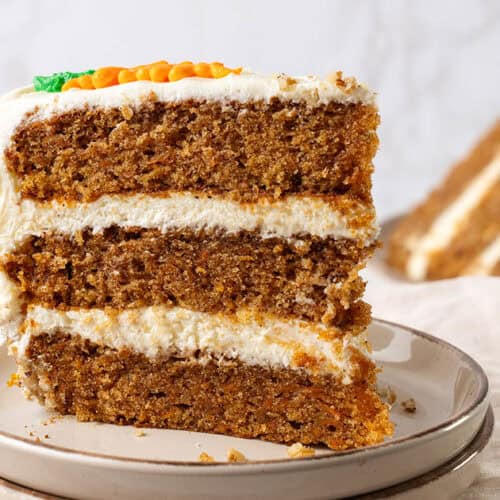
- For the carrot decoration, color one portion of the cream cheese frosting green and the other orange using high-quality gel food coloring. Transfer the colored frostings into two separate piping bags fitted with a small round nozzle. Pipe carrot shapes on top of the cream cheese frosting, as shown in the picture.
- To complete the look, finish the decor with chopped walnuts sprinkled over the top and around the edges, as shown in the image.
Storage
- Store the carrot cake in the refrigerator, covered or in an airtight container, for up to 3 days. Because of the frosting, it needs to be kept chilled.The assembled carrot cake should not be frozen, as the frosting and structure won’t thaw well. However, the sponge layers freeze very well. Once completely cooled, wrap each sponge tightly in plastic wrap and then in foil, or place them in an airtight container. The sponges can be frozen for up to 2–3 months without losing quality.To use, thaw the sponges in the refrigerator overnight while still wrapped, then bring them to room temperature before assembling the cake and adding the frosting.
Notes
- Measure your ingredients with a digital scale for accuracy.
- All cake ingredients must be at room temperature to properly emulsify.
- Use freshly grated carrots rather than pre-shredded ones. Pre-packaged carrots are drier and thicker, resulting in a drier crumb.
- For the frosting, it is important to use high-fat content cold cream cheese and mascarpone to achieve a stable, not runny frosting.
- Do not overmix once flour is added. Mix only until the dry ingredients are incorporated. Overmixing develops gluten, making the cake dense rather than soft and tender.
- Baking these sponges takes 25 minutes in my oven. However, you should focus on the texture, not the time. Apply the toothpick test (it should come out clean) to avoid overbaking your cake; overbaking results in a dry texture.
- Weigh your batter between pans if you want perfectly even layers. The same applies to frosting in between the layers.
- Cream cheese frosting is very easy to overwhip. When whipping, stop as soon as the mixture reaches a fluffy consistency and forms stiff peaks. It won't get stiffer after this point. In fact, if you overbeat it, it will only get runnier and then break.
- Cool layers completely before frosting. Even a slightly warm cake will melt the frosting, weaken the structure, and cause sliding during assembly.
- For the carrot decoration, only use concentrated high-quality gel food coloring, e.g., Americolor; we don't want to ruin the frosting with cheap supermarket food coloring.
Luke
I always thought making carrot cake was complicated and that only professional bakers could do it. Little did I know that with your recipe, I could make even better carrot cakes. This is seriously better than anything I've ever bought!! So moist, fresh, and not too sweet.
Rana
If you’re looking for a recipe that’s incredibly delicious, easy to follow with very easy clear step-by-step instructions, and also looks impressive when finished, this is exactly the recipe you need. The directions are detailed and beginner-friendly, the result is absolutely delicious, and it turns out beautiful every time. Highly recommended!
Peter Moor
Btw, my family is Hungarian as well. I grew up in the Netherlands but both of my parents are from Hungary.
Go figure!
Katalin Nagy
So happy to hear, great that you loved my carrot cake:) Köszi!
Peter Moor
Turned out great. Cake layers (Btw part of the recipe implies that there's only one layer which could be a bit confusing to novice bakers) were beautifully moist. Had to bake it a few minutes longer than mentioned, close to 30 min. Thanks for the recipe.
Any way I can attach a photo?