
Food prices have climbed sharply over the past few years. According to the United States Department of Agriculture data, grocery costs rose by more than 23 percent between late 2020 and late 2024. Everywhere you look, people are feeling the squeeze from higher food prices that seem to be rising day by day.
But not all news about grocery pricing is negative. There is a positive advantage to keep in mind: shoppers can adjust where and how they buy, but it is getting harder, and you need to be more cautious than ever.
Most Americans buy food from at least two retailers each week. But which ones you choose can have a big impact on your overall spending

A 33 percent price gap
The comparison, conducted by Strategic Resource Group on behalf of Consumer Reports, examined baskets of commonly purchased items across six metro areas in different regions of the country. The baskets included various items of produce, meat, and packaged goods. Shelf pricing was gathered within tight time windows to maintain consistent comparisons. Sale prices and free loyalty discounts were included. Manufacturer coupons and app-only deals were not.
When SRG compared prices on baskets of commonly purchased items at mainstream grocery chains in six regionally representative cities across the U.S., the difference between the highest- and lowest-priced items in each city was more than 33%. And when the comparison included the warehouse clubs like Costco and specialty grocers like Whole Foods, the price differences were even more significant.
That kind of difference is not minor. For a household spending $200 a week, a 30% price difference could mean thousands of dollars over the course of a year.
Not all baskets are the same
The comparison baskets varied by store format. For large supermarkets that carry many identical brands, it was easy to compare similar items across stores.
For specialty retailers or chains that focus heavily on private-label products, the baskets were smaller because fewer items were directly comparable.
That nuance matters. A store that emphasizes unique private-label goods or specialty products may not be directly comparable across every item. Still, the overall totals provide a broad sense of relative pricing.
Who was the cheapest

To create a clear benchmark, Walmart was chosen as the baseline retailer due to its scale and national presence. Other chains were measured as a percentage above or below Walmart’s basket totals.
On a national average across the six metro areas, warehouse clubs came in well below that baseline. Costco Wholesale and BJ's Wholesale Club had the lowest prices, about 20% below Walmart's.
Discount-focused chains also performed well. Lidl and Aldi both came around 8% below Walmart on average. Regional operators such as WinCo and H-E-B were close to or slightly below the baseline.
Who was the most expensive
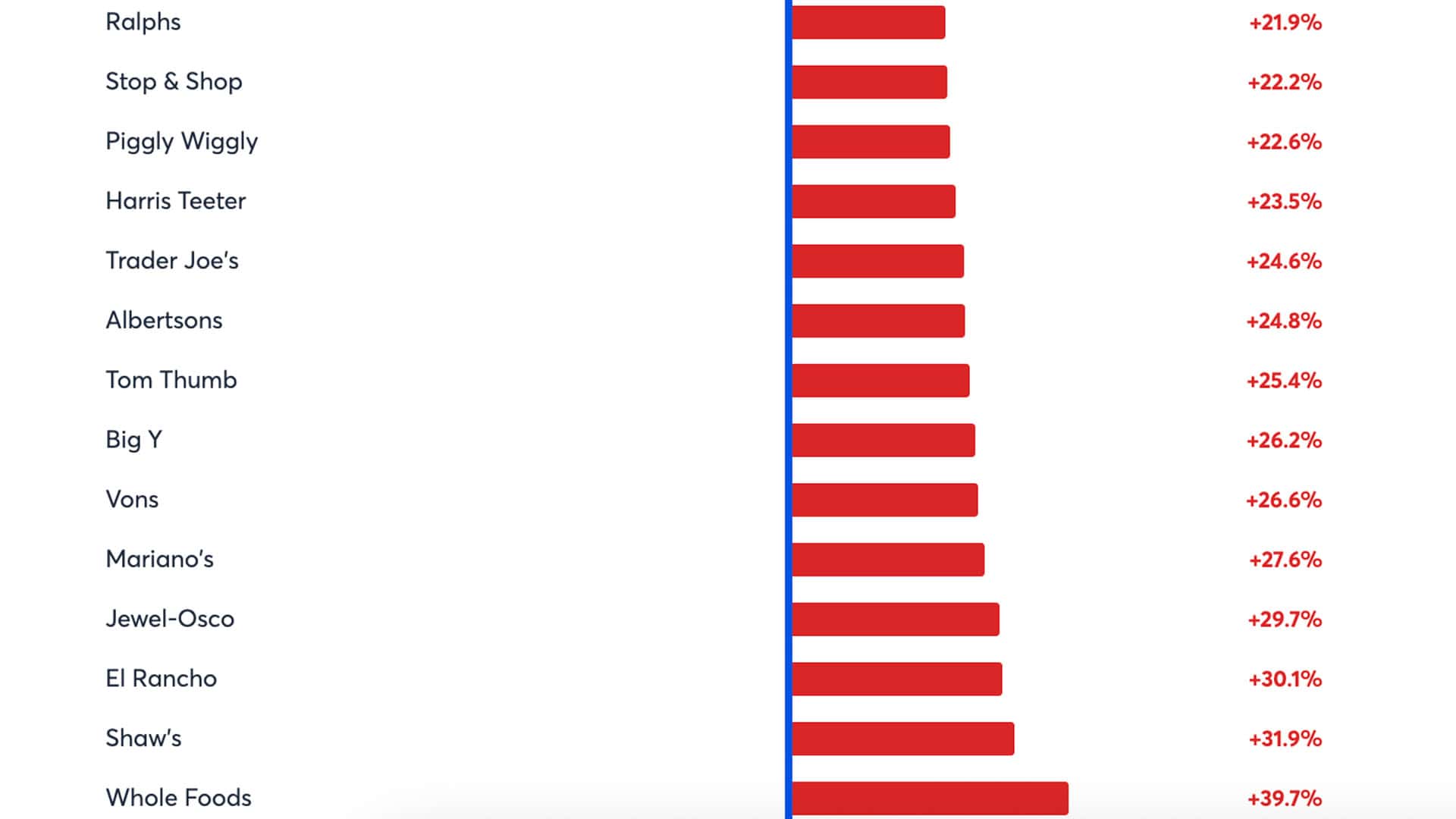
On the higher end, several supermarket chains landed well above Walmart’s totals. Kroger averaged nearly 15% higher. Publix was more than 20% higher, and Trader Joe's averaged nearly 25% higher in the baskets compared.
At the top of the list was Whole Foods Market, which averaged close to 40% higher than Walmart across the locations studied.
These percentages reflect average differences across metro areas. In specific cities, the spread between the least and most expensive stores was even more dramatic.
Why the differences are so large
Several reasons help explain the wide pricing gaps. Warehouse clubs such as Costco and BJ’s operate on membership models and sell in bulk. Their scale and limited product variety can keep unit pricing low, especially on packaged goods and household staples.
Discount grocers like Aldi and Lidl focus on store brands and streamlined operations. Fewer service departments and tighter inventory management reduce overhead, keeping costs lower.
Traditional supermarkets carry a wider range of national brands and specialty items. Those features add convenience and variety, but they also raise overall basket totals. Specialty chains focus on sourcing standards and curated selections. This costs more, which is passed down to consumers.
Most Americans already shop at more than one grocery retailer each week. The data suggests that the strategy can pay off.
The findings also highlight the value of reviewing ongoing sales and paying attention to where food staples are consistently cheaper.

Metro area differences
The rankings also shifted by city. Local competition plays a major role. In markets where warehouse clubs and discount chains have strong footprints, mainstream supermarkets price more aggressively.
Costs tied to labor and real estate also vary by region. A chain that appears midrange in one metro area could rank closer to the top or bottom in another.
The study provided both national averages and city-by-city comparisons, showing that pricing is not uniform across the country.

The bottom line
Food inflation has reshaped household budgets. With meat and dairy near record highs and coffee up sharply, the pressure is real. But grocery spending remains one of the few major expenses people can adjust.
The recent pricing analysis shows that the gap between the most and least expensive supermarkets is not trivial. In many cities, it exceeds 30%.
Choosing the right store, or combination of stores, will not reverse national food inflation. It can, however, help families absorb some of the shock. In a high-cost environment, the sign above the entrance may be one of the most important financial decisions made each week.
Leave a Reply