
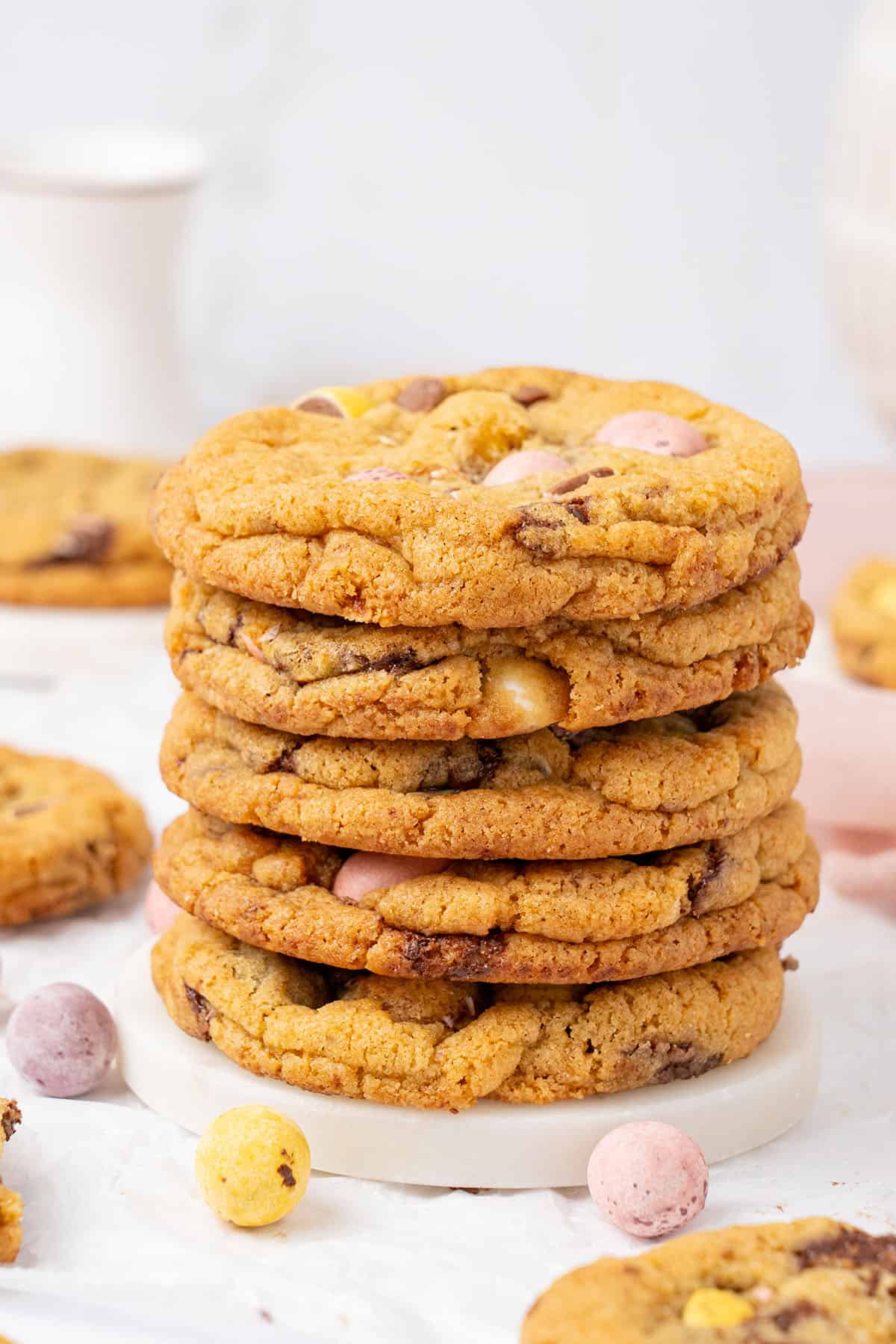
These Easter Egg Cookies are chewy, gooey, and buttery, sweet but not overly sweet; they are the easiest baking choice for Easter! The crunch and color pop of the chocolate Easter eggs make them so festive and cute, as well as extra tasty. Everyone will love them!
Best Easter Egg Cookies Recipe
Making these Easter cookies recipe is as easy as making my popular Chocolate chip cookie recipe! No special equipment is needed, and it comes together in 15 minutes; this might just be the most effortless Easter baking ever.
I use my secret baking hack for chewy cookies, which mixes brown and white sugar, and then we rest the cookie dough before baking. And, of course, we never overbake! There is nothing worse than overbaked cookies with crumbly texture.
Finding a more delicious Easter recipe with such minimal effort is challenging. Even if you are a beginner in the kitchen, you can comfortably try this recipe. Trust me!
Katalin's Take On What Easter Eggs to Use to Make These Cookies
When it comes to chocolate Easter eggs, quality is really important. Low-quality products won't melt properly when baked, can go greasy, and have an inferior flavor. You want real chocolate with a colorful sugar coating (like Cadbury Mini Eggs) to bake the best cookies.
The size is also crucial so they look proportional to the cookies. We will be crushing some of them and mixing them into the dough (like we do with chocolate chips), and halfway through baking, we will place more mini Easter eggs on top for the most perfect visual appearance.

Ingredients
Easter Egg Cookies
- 150 g (⅔ cup) Unsalted butter at room temperature
- 50 g (¼ cup) Brown sugar
- 100 g (½ cup) Granulated sugar
- 1 Egg at room temperature
- 1 teaspoon Vanilla extract
- 190 g (1½ cups) All-purpose flour
- 1 teaspoon Salt
- 1 teaspoon Baking soda
- 120 g (⅔ cups) Mini chocolate eggs good quality real chocolate eggs eg. Mini eggs, Cadbury mini eggs etc.
- 85 g (½ cups) Semi-sweet chocolate chips, good quality, e.g. Valrhona or Callebaut
Make the Cookie Dough
With the help of an electric hand mixer, cream together room-temperature butter and both kinds of sugar for a few minutes until pale and creamy.

Mix in the egg and vanilla extract just until combined. Do not overmix.
Sift the flour, baking soda, and salt (the dry ingredients) into the wet ingredients and fold them together just until combined. Don't use the mixer for this stage. Over-mixing ingredients can incorporate too much air and gluten into the mixture, which can give the Easter cookies a crumbly, cake-like texture.

Fold in the chocolate chips, chop half of the mini chocolate eggs into chunks, and fold those in, too.
Line 2 trays with a baking sheet or silicone baking mats. Divide the cookie batter into 10-12 equal-sized balls of cookie dough using a cookie scoop (weigh them if you like to ensure they are even).
Place the cookie dough balls on parchment paper, leaving enough space between them to spread as they bake. Do not smooth or soften the surface of the ball; in fact, try to keep it as rough as possible for a nice, crackly surface.

Don't Skip Chilling the Dough Before Baking
We always aim to achieve thick, fudgy cookies that don't spread too much in the oven. This means you have to chill the cookie dough for at least 1 hour before baking. No one wants over-spread, sad-looking, flat Easter egg cookies! The warmer the dough, the easier it will spread in the oven.
You might come across "no chill cookie dough" on the Internet, but I can almost guarantee that the dry vs wet ingredients are unbalanced, and when they are baked, they become dry. If you don’t have an hour to wait, try to chill them for 15 minutes in the freezer instead while the oven preheats.
Bake, but Don't Overbake
Preheat the oven to 175°C / 350°F (no fan) while the dough is chilling.
Bake the cookies for 16-18 minutes in total in the following way: bake for 12 minutes, then take them out and add the remaining chocolate egg halves. Then, continue baking for 4-6 more minutes. The cookies are ready when the edges look baked and the middle is slightly gooey (but not raw).
Leave the cookies on the baking pan while they are still hot, and after around 5 minutes, transfer them to a wire rack. I like to sprinkle over some sea salt at this point! Salt helps to balance the flavors and enhance the rest of the ingredients.
The cookies are best eaten freshly baked when the chocolate eggs are melted. So delicious!

This Is How To Store Leftovers
Store leftover cookies (if there are any) in an airtight container on the counter for 2 days, or they will last up to 5 days in the fridge.
You can freeze the dough really easily at the chilling stage. And I love to do this with my favorite cookie recipes as it means I can have cookies on demand whenever I fancy it! Place the dough balls in the freezer on the tray and then transfer them into ziplock bags once frozen. You can even bake them without defrosting; they might just need a couple of more minutes in the oven.

Expert tips for making Easter egg cookies
- The egg and butter in this Easter cookie recipe must be at room temperature to emulsify properly. Butter takes around an hour out of the fridge to soften sufficiently. Avoid last-minute microwaving! Read my guide on how to soften butter quickly.
- Don't overfill the baking sheet. I suggest baking 5-6 cookies per sheet to allow space for spreading.
- For an extra crinkly surface on your cookies, bang the whole tray gently to the kitchen counter 3 or 4 times when you add the extra Easter eggs.
- For perfectly round cookies, apply the circular trick. After the tray banging, grab a large cookie cutter and make circular movements around the almost-baked cookies to tighten the edges. You can repeat this step after baking, too.
- Please note that you might need to experiment with your oven when it comes to baking time. All ovens vary!

Useful Equipment List
Always weigh ingredients using a digital scale for precision.
Mix the cookie batter using either an electric hand mixer or a stand mixer. Switching to a rubber spatula is ideal for gently incorporating the dry ingredients into the wet mixture without overmixing.
Oven temperatures can also vary, so ensure you are baking at the correct temperature using a digital oven thermometer.
After baking, transfer to a cooling rack to allow the Easter cookies to cool down before enjoying.
Try some of my other cookie recipes
- Brownie Cookies
- Lemon Curd Cookies
- Tiramisu Cookies
- Raspberry Cheesecake Cookies
- Lemon Ricotta Cookies
Make sure to also check out my Spring Desserts recipe collection! And if you're baking for Easter, you must make hot cross buns - check out this recipe for hot cross buns from Heidi.
Leave a Reply