
Chewing gum is an everyday item we often buy on a whim, chew for a little while, and then throw away without much thought. Since we don’t usually think of gum as food, many people don’t really consider how it’s made or what gives it its chewy, softer texture.
Itay Shechter, a famous content creator, has caught people’s attention by showing how chewing gum is made, using simple, clear steps anyone can understand.
Disclaimer: The article does not claim that commercially available chewing gum is unsafe to consume. The video is intended for educational and entertainment purposes only and should not be attempted at home.
The video begins with Shechter stating, “Let’s make your favorite chewing gum at home.” He then immediately explains that the most popular chewing gum today is made from plastic. He clarifies that this plastic is a form of synthetic rubber, chemically similar to materials used in tires, industrial adhesives, and sealants. To illustrate that point, he introduces an old tire as the visual starting material.
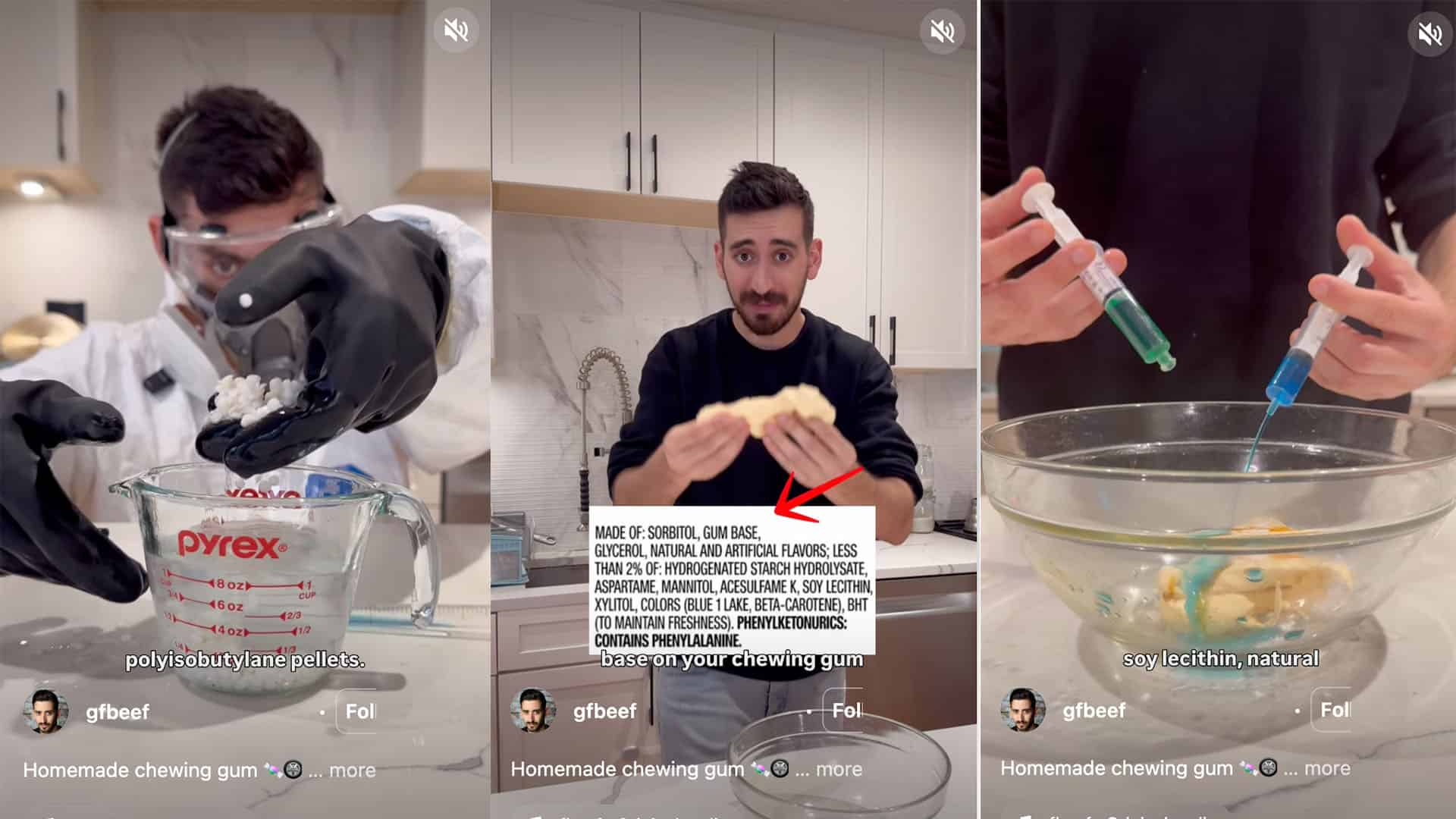
He then isolates the compound from the tire, shreds it, and dissolves it in an industrial solvent. Sulfuric acid is then added, allowing the mixture to react and precipitate, leaving behind small pellets of polyisobutylene (a synthetic rubber). These pellets, he says, represent the base material that gives chewing gum its elasticity and chew.
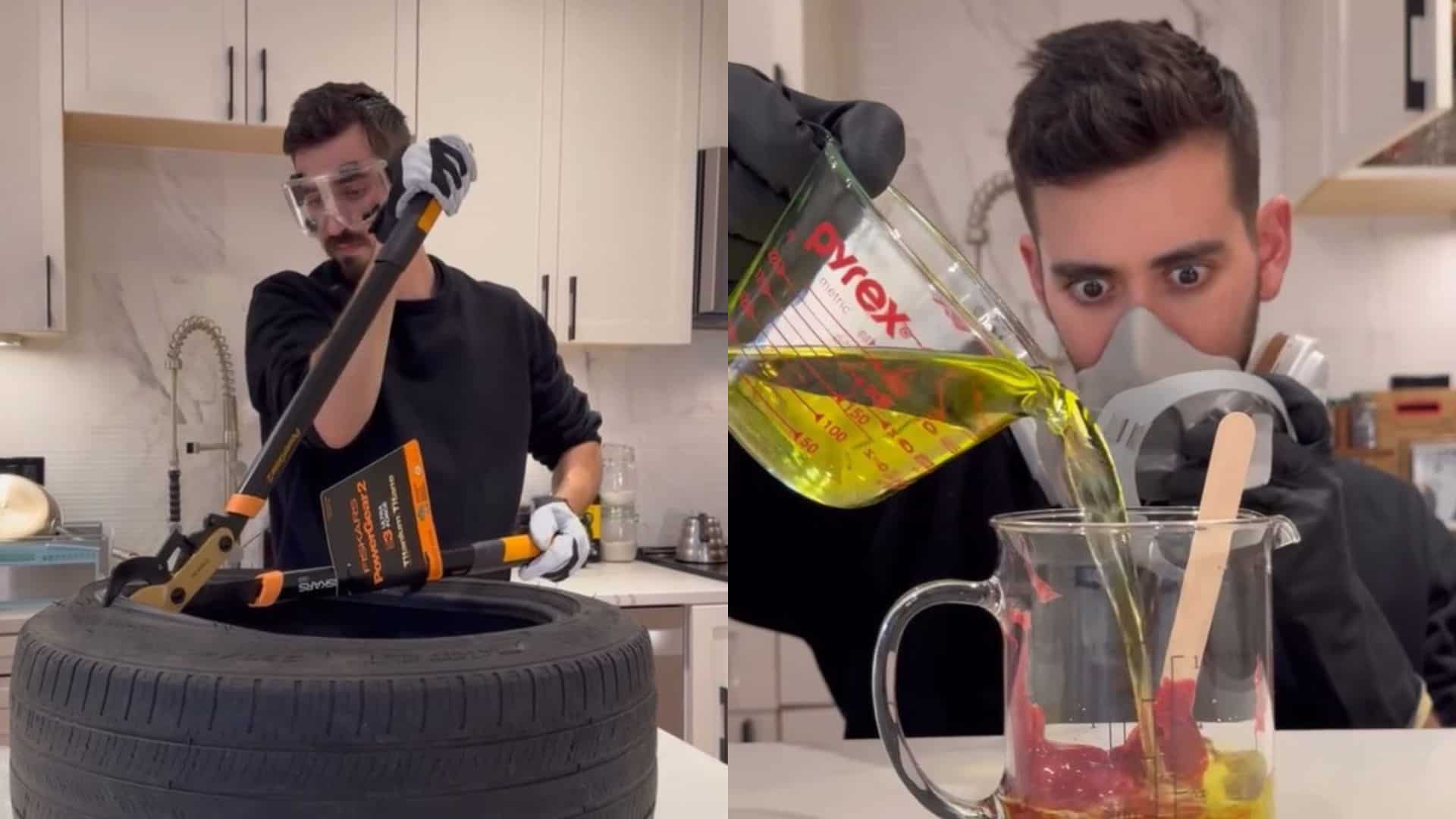
To make the gum base softer and more chewable, he uses industrial lubricant, which is run through solvents such as hexane and toluene and then instantly chilled to create petroleum paraffin wax. This wax is mixed with the polyisobutylene pellets to modify the texture.
Resin plasticizers are added next, including the glycerol ester of rosin, an oil-soluble food additive. He explains that when people see “gum base” listed on chewing gum labels, it refers to a combination of synthetic rubber, waxes, and resins.
The video then moves on to the remaining ingredients. He adds artificial sweeteners, glycerin, and polylecithin. Titanium dioxide is also added to make the gum appear brighter, even though he shares that it is banned in the European Union. He adds that only a small amount is used and that it may not even appear on the label because it can be classified as a processing aid.
Finally, the mixture is combined and shaped into gum. For appearance, a petroleum-derived food dye is added to give it a minty look. He ends the demonstration by asking viewers whether they would chew something made this way.
The reactions
Thousands of people commented on the video, and most were surprised to learn about the entire process. One person wrote, “Makes you wonder what else we eat without really knowing the process!” People are now more curious about how the food that they consume every day is made, especially something as small as a chewing gum, which almost everyone keeps with them all the time.
Many people were shocked by the process and said they would not chew gum again. The process made them uncomfortable, and they were surprised by how the gum might have been made behind closed doors. Many others took the whole process lightly. “Wow.. ‘chewing miles’ must be the name of this product,” one person joked. Another added, “Thanks, bro. Now I never buy chewing gum anymore, I just chew on the car tires in the parking lot.”
Some were concerned by the demonstration and asked what else they could have instead of chewing gum. While there is no single replacement that works for everyone, taking a moment to check ingredient labels and think about why you reach for gum in the first place can help you make more deliberate choices.
The takeaway
Shechter's video obviously does not show how chewing gum is exactly made in factories. He simplified the process so viewers could clearly see the chain of production behind a product that almost everyone enjoys.
Chewing gum is often seen as small and disposable, which is why most people never think about how it’s made. Shechter didn’t argue for or against chewing gum. Instead, he simply highlighted what potentially goes into processed items that people don’t even think about before consuming them.
In the end, everyone makes their own choices about what to eat or snack on. However, understanding what goes into the things we eat provides valuable information that many people might not usually consider.
Leave a Reply