
Key Points
- The Pentagon Pizza Index suggests that spikes in pizza orders near the Pentagon and CIA may coincide with looming crises, based on anecdotes dating back to the 1980s.
- Recent monitoring, such as the Pentagon Pizza Report on X, tracks Google Maps activity at local pizzerias to identify unusual surges in real-time.
- While entertaining and occasionally correlated with events, experts caution that the index is anecdotal, prone to confirmation bias, and lacks statistical validation.
- The concept remains more of a quirky piece of intelligence folklore than a reliable forecasting tool.
What Is the Pentagon Pizza Index?
The "Pentagon Pizza Index", sometimes referred to as the "Pizza Meter" or "Pentagon Pizza Theory", is a curious notion that sudden spikes in pizza orders near government buildings, such as the Pentagon, CIA, or White House, may indicate major national crises. The idea originated from anecdotal observations in the 1980s and 1990s during some highly tense national moments when local pizzerias would experience late-night surges in orders.
One often‑cited example was on August 1, 1990, the CIA reportedly ordered a record 21 pizzas in a single night just before Iraq invaded Kuwait.

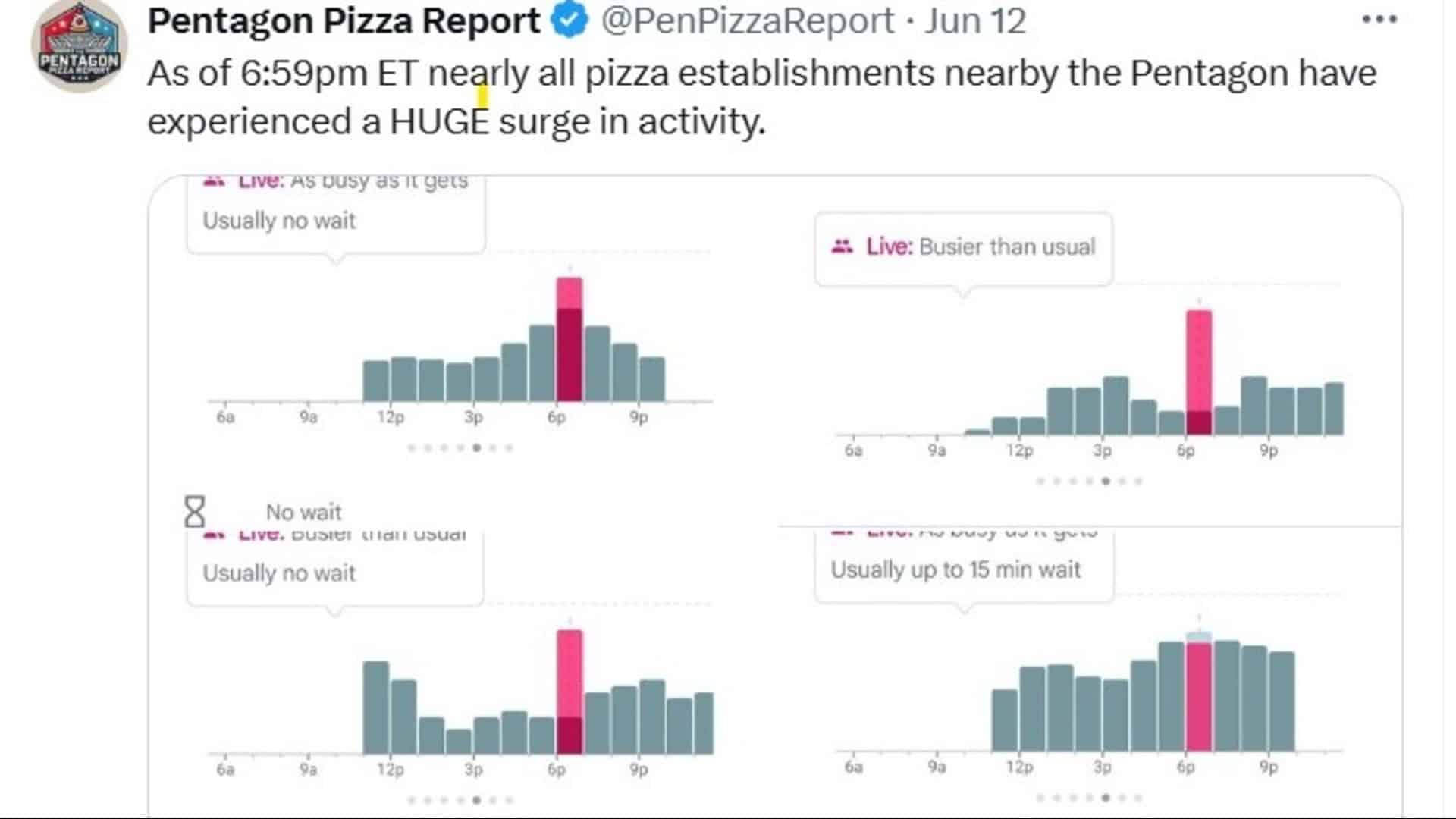
In recent years, the concept has evolved into a real‑time tracking tool. The X account Pentagon Pizza Report monitors Google Maps’ “live visit” or “popular times” data for pizza spots near the Pentagon and notes when activity sharply deviates from norms.
How Reliable Is the Pentagon Pizza Index as a Crisis Predictor?
The pizza index is mostly based on stories and speculation, but it’s stuck around long enough to become a regular part of conversations about quick, quirky warning signs of what is looming in the nation. There are quite a few historical instances where the pizza index surged, followed by a major national event such as:
- Before the U.S. invasion of Grenada (1983) and Panama (1989).
- On the eve of the Gulf War, there were reported late‑night order surges at the Pentagon and CIA.
- In December 1998, amid the impeachment of Bill Clinton and the Kosovo conflict, deliveries near the White House increased substantially.
There have also been many more recent events. For example, in June 2025, the Pentagon Pizza Report flagged a significant surge in foot traffic or “live visit” metrics around 7 p.m. ET at District Pizza Palace, just hours before Israel’s major operation against Iran. This instance led people online and some media outlets to revive the idea that pizza orders can signal a coming crisis.
Expert and Official Views
When it comes to the Pentagon Pizza Index, critics generally advise caution. Zenobia Homan, a senior research fellow at King’s College London, characterizes the index as prone to confirmation bias. “My initial thought is to be sceptical because it sounds like a case of confirmation bias. I’m not saying they’re wrong, but I want to see way more data. When else do spikes occur? How often do they have absolutely nothing to do with geopolitics?”
She correctly points out that many traffic spikes and pizza order increases may have no geopolitical relevance at all. There are many reasons why a pizza parlor may see an increase in traffic, not just because of a major political occurrence.
The U.S. Department of Defense has also downplayed the reliability of the index. One important point is that the Pentagon houses its own food vendors, available to personnel working overnight, thus reducing the need to order from outside businesses.
Others call it nonsense
Marcel Plichta, a former analyst for the U.S. Department, argues in one of his latest posts that at the most basic level, there is no consistency about which pizza places count at any given time. Even if proponents of the index standardized a list of pizza places, we are left with two main assumptions underpinning the whole thing: that Pentagon workers buy pizza during crises, and that jumps in activity in pizza places near the Pentagon are due to purchases made by famished national security officials.
Neither assumption holds up to scrutiny. For instance, Google determines if a location is busy based on the location data of users physically at the venue, meaning that we would need to assume that Pentagon employees react to crises by dashing to their cars (past the numerous restaurants and stores already in the building) and then piling into the stores.
What Makes the Pizza Index Thought-Provoking?
The Pizza Index exemplifies how unconventional public signals, such as simple food orders, can serve as low-tech intelligence predictors. These gauges are especially valuable when more formal indicators are unavailable or lag behind. Analysts and hobbyists are increasingly using tools like Google Maps for location-based cues and hints into what is happening behind closed government doors. In this way, the Pizza Index illustrates both the promise and pitfalls of DIY armchair analysis.
The idea of "pizza predicting crises" lives on as both an entertaining meme and a quirky concept in intelligence folklore. One Redditor jokingly grouped it with other informal indicator; "I love how we have the pizza metric for political crisis and the Waffle House metric for natural disasters."
So, Is It Credible, or Just a Slice of Myth?
The Pentagon Pizza Index occupies a gray area that is clever and attention-grabbing, yet far from a rigorous or reliable intelligence tool. Let’s break it down into the simplest of terms.
Strengths:
- Historically consistent enough to warrant repeated mentions.
- Highlights how everyday data can feed into broader situational awareness.
- Offers a playful angle on busy officers ordering pizzas while staying late and handling major world events.
Limitations:
- Mostly anecdotal, cases where spikes didn’t correspond to crises are underreported.
- No publicly available statistical validation of its predictive power, such as how false positives can occur Mostly anecdotal, cases where spikes didn’t correspond to crises are underreported.
- No publicly available statistical validation of its predictive power, such as how false positives can occur
- Google’s “Popular Times” and live busyness data aren’t based on pizza orders. They’re calculated from location data on people’s smartphones (how many devices with Google services are physically present at the business). That means a spike in “busyness” just shows more people are inside (or very close to) the pizza shop — it says nothing about how many pizzas were ordered or why they were there.
If you ask me, it’s a myth primarily because of how the data is calculated. Google’s “live busyness” metrics don’t track how many pizzas are being ordered. In other words, the spike reflects foot traffic, not food orders. That makes the so-called “Pentagon Pizza Index” a shaky measure at best, since more people standing inside a pizza shop doesn’t necessarily signal a looming military operation.
Leave a Reply