
A Delta Air Lines flight from Los Angeles to Salt Lake City was forced to return to Los Angeles International Airport after an odor spread through the cabin.
Flight 2311 departed Los Angeles on Oct. 18 but turned back roughly halfway into its route after crew members reported a ‘strong smell’ on board. The Airbus A321 was carrying 189 passengers, two pilots, and four flight attendants.

Delta said the odor did not come from its catering service. It originated from spoiled food that a passenger had brought onto the plane.
“As nothing is more important than the safety of our customers and people, our crew followed standard procedures to safely return to Los Angeles after an unpleasant odor was detected onboard,” the airline said in a written statement. “We apologize to our customers for the delay in their travels.”
The flight was safely diverted to Los Angeles International Airport (LAX) after the odor was detected. No injuries or medical issues were reported, and Delta rebooked travelers on another aircraft to complete their trip to Salt Lake City.
Similar incidents from the past
This is not the first time a flight has been diverted due to unusual cabin odors. In the past, several local airlines, including Delta, have faced similar issues that led them to divert planes.
Delta flight from Boston to New Orleans
A similar issue occurred in March when Delta Flight 1398, traveling from Boston Logan International Airport to New Orleans, turned back shortly after takeoff. The flight crew reported a “smoky odor” in the cabin and declared an emergency to receive priority handling from air traffic control.
The Airbus A220, which had 87 passengers on board, landed safely back in Boston, where it was met with emergency personnel as a precaution. Delta said its crew followed standard safety procedures and apologized to travelers for the delay.
Delta flight from New York to Orlando
In February 2025, Delta Flight 2090 from New York’s John F. Kennedy International Airport to Orlando was diverted to Raleigh-Durham International Airport in North Carolina after an odor was detected in the cabin.
The Airbus A321, carrying 158 passengers, landed safely, and customers were transferred to another aircraft that reached Orlando later that evening. The airline did not disclose the cause of the odor, and no medical issues were reported.
Alaska Airlines flight from Hawaii to Seattle

Another case involving a strong odor occurred in September 2024, on an Alaska Airlines flight from Kauai, Hawaii, to Seattle. Flight 810 diverted to Honolulu after four flight attendants reported an “unidentifiable odor” and began feeling unwell. The flight landed safely, and the crew members were taken to a hospital for evaluation. None of the pilots or passengers required medical attention.
These recent cases show that odor-related diversions, while uncommon, are handled with strict safety protocols and often result in aircraft inspections or crew evaluations before service resumes.
Which foods to bring on a flight?
Passengers are free to bring food from home, but experts and the Transportation Security Administration (TSA) say it’s best to bring foods that are easy to store, don’t spill, and won’t bother others in a shared cabin. Smells carry quickly on planes, and some foods can become unpleasant at altitude or when reheated.
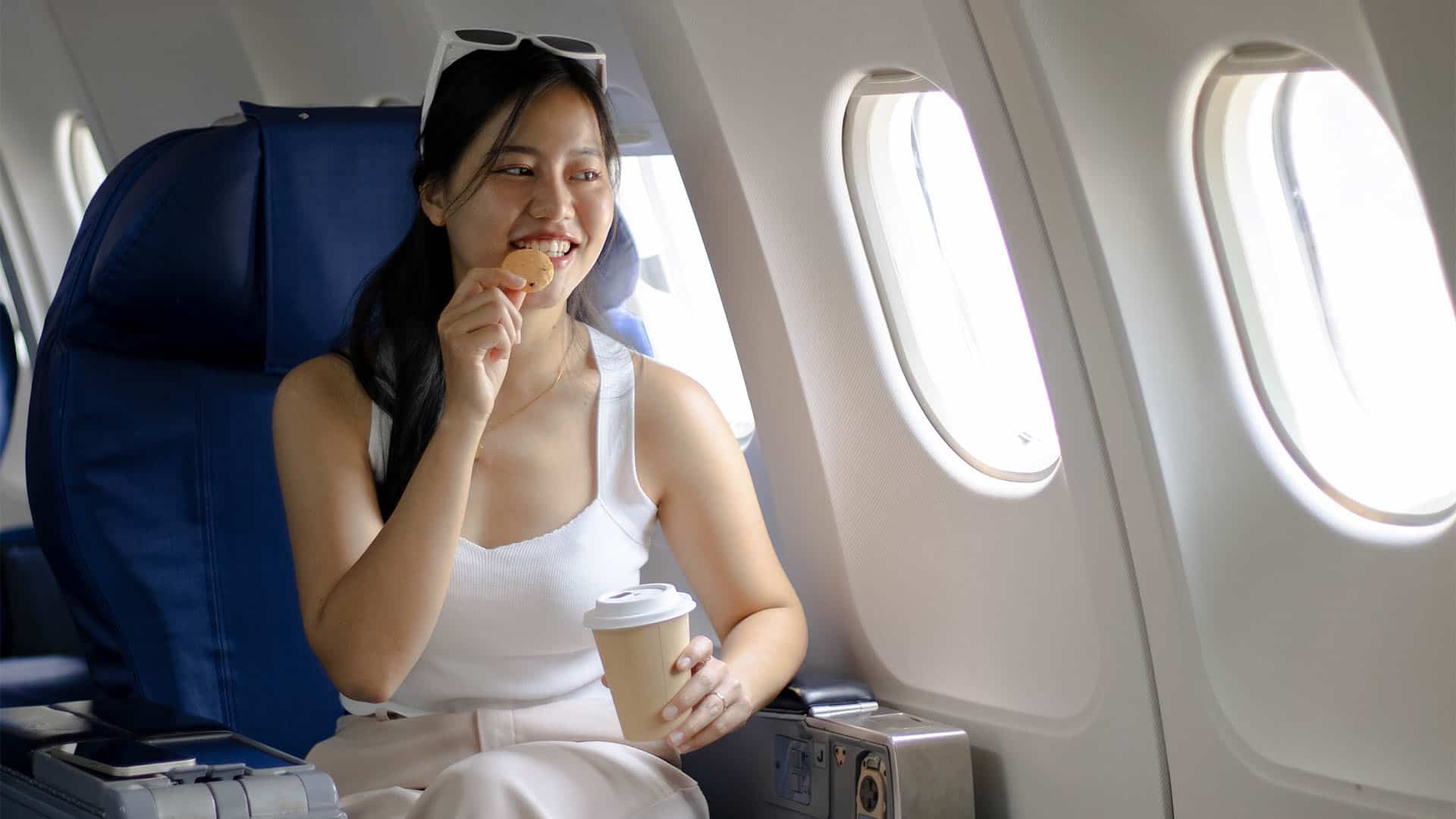
1. Neutral-smelling snacks
Dry snacks such as crackers, nuts, granola bars, and pretzels travel well and have little to no odor. They also meet TSA’s solid-food rules and don’t require refrigeration or special handling.
2. Simple sandwiches
Cold sandwiches with cheese, turkey, or vegetables are fine to bring on board. Passengers should avoid tuna, hard-boiled eggs, and foods containing garlic or onions, as these can produce strong odors in confined spaces.
3. Whole fruits and vegetables
Fruits like apples, oranges, and grapes, or vegetables such as carrot sticks, are TSA-approved and naturally low-odor. Sliced items should be stored in sealed containers to keep them fresh and contained. If you’re bringing hummus with veggies, make sure it’s stored in a 3.4oz/100 ml container.
4. Dry protein choices
Items such as jerky, baked chicken strips, or tofu bites are allowed in carry-on bags. Fried foods, which can emit stronger scents, should be packed in checked baggage or eaten before boarding. Protein items should be fully cooked and cooled before travel to meet food safety standards.
5. Baked goods
Bagels, muffins, and cookies are simple, low-odor options for a flight. Solid pastries, such as croissants or biscuits, can remain in carry-ons and don’t need to be declared.
6. Liquids
If you want to bring a drink, juice, shake, or any other liquid in your carry-on bag, you must follow the TSA’s “3-1-1” rule. That means each container must hold 3.4 ounces (100 milliliters) or less, and all the containers must fit into one small clear bag. However, rules for international flights may vary. Travelers should review both TSA and airline policies before departure, as some foreign airports have stricter liquid restrictions or additional screening procedures.
Leave a Reply