
Grocery shopping has become a growing strain on household budgets. With food prices steadily rising, the grocery bill now ranks among the most significant monthly expenses for many families and individuals.
But have you ever wondered how much other people in the USA are spending on groceries? Where do you rank compared to what the average person spends? Are you spending too much, or are you a frugal shopper below the average? Let's take a look at some fascinating grocery spending facts and find out!
How Much Does The Average Household Spend on Groceries Per Month?

According to the Bureau of Labor Statistics, the average American spends about $6,053 per year ($504 per month) on groceries, categorized as "food at home." Of course, your actual grocery bill could be quite different, as the amount you spend will depend on several key factors, including where you live, the size of your household, your eating habits, and your preferred shopping location.
Families who cook most meals at home using basic ingredients often spend less than those who rely on prepackaged foods or shop at upscale grocery stores. Location is another major factor, as regional price differences can make the same grocery list significantly more expensive or more affordable depending on where you live.
How Much Should You Spend on Groceries?
There is no single number that determines precisely how much you should spend on groceries each month. However, the U.S. Department of Agriculture (USDA) provides monthly food plans that estimate the cost of eating a nutritionally adequate diet at three budget levels: Low-Cost, Moderate-Cost, and Liberal. These plans serve as benchmarks for budgeting, financial planning, and are sometimes used in legal contexts such as divorce or child support cases.

The USDA food plans outline estimated food spending at three budget levels: Low-Cost, Moderate-Cost, and Liberal. Updated monthly, these plans break down expected grocery costs based on household size, age, and spending habits. Each plan is based on a model “market basket” of foods that reflects the types and quantities needed to meet current nutritional guidelines within the given budget.
For instance, the Liberal Plan may include more convenience items or premium products, while the Low-Cost Plan focuses on basic ingredients and home cooking. Each basket includes hundreds of specific food items in varying quantities, providing a practical estimate of what individuals or families might typically spend on groceries each month.
Below is a quick reference chart from the USDA's March 2025 food plans.
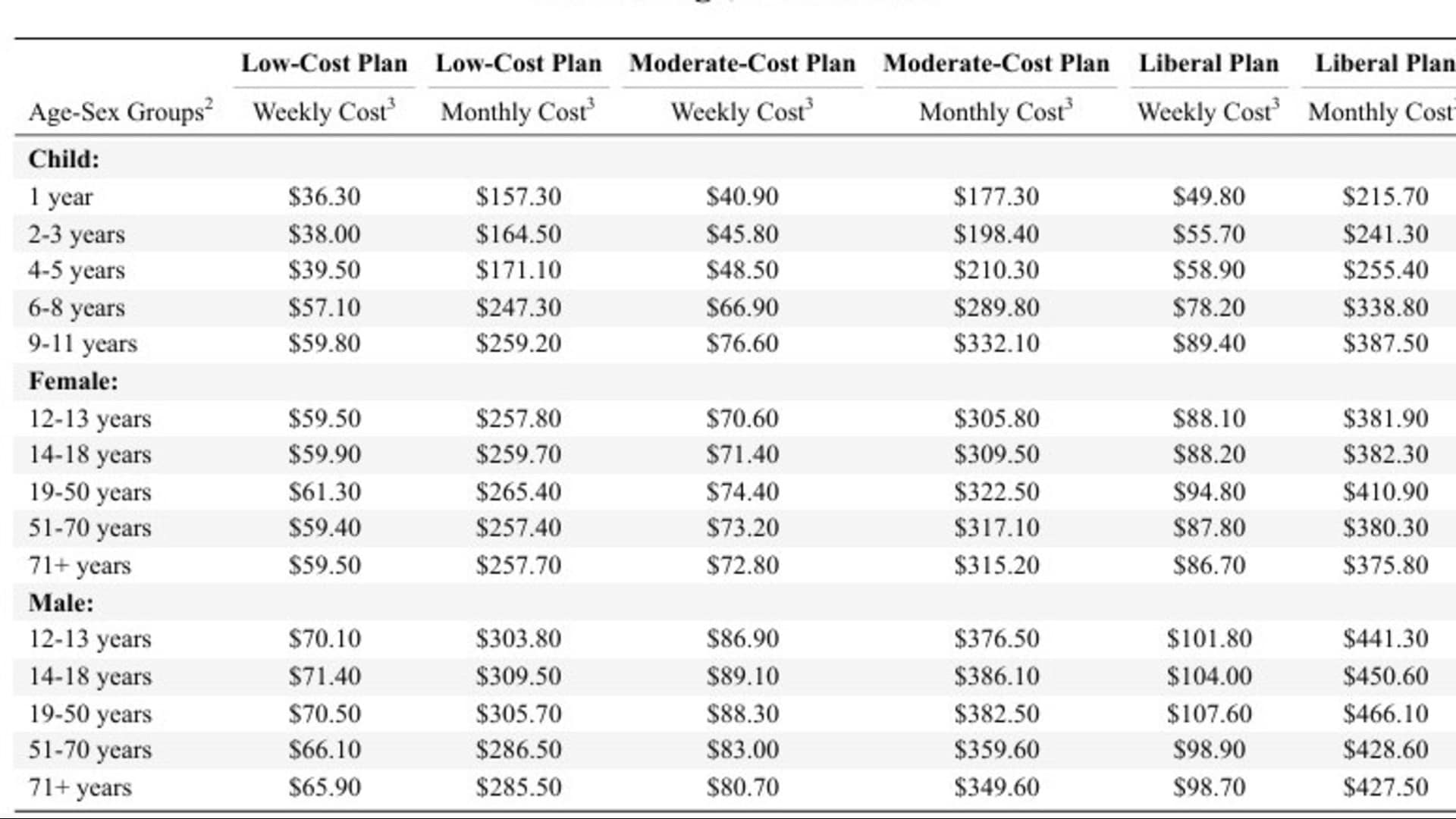
The food cost estimates are based on individuals in a four-person household. If your household size is different, you can adjust the numbers using these guidelines:
- 1 person — add 20%
- 2 people — add 10%
- 3 people — add 5%
- 4 people — no adjustment needed
- 5 or 6 people — subtract 5%
- 7 or more people — subtract 10%
To estimate your total household food cost:
- Add up the individual food costs for everyone in your household.
- Then, apply the adjustment factor based on your household size.
Again, keep in mind that these are not strict rules; however, the information can help you determine what is realistic for your lifestyle and budget.
Is Your Household Grocery Budget Above or Below Average?
You can use the USDA food plan to estimate your monthly grocery budget and help you figure out if you are currently spending too much on your monthly grocery bill. Let's do the math, utilizing the chart above.
Monthly Food Cost Estimates for a 2-Adult Household (Ages 19–50)
| Plan Level | Male Cost | Female Cost | Total Cost | +10% Adjustment | Final Monthly Cost |
|---|---|---|---|---|---|
| Low-Cost | $305.70 | $265.40 | $571.10 | $57.11 | $628 |
| Moderate-Cost | $382.50 | $322.50 | $705.00 | $70.50 | $775 |
| Liberal | $466.10 | $410.90 | $877.00 | $87.70 | $964 |
Monthly Food Cost Estimates for a Family of Four: two adults (Male & Female, Ages 19–50), two children (Ages 6–11)
| Plan Level | Adult Male (19–50) | Adult Female (19–50) | Child (6–8) | Child (9–11) | Total Monthly Cost |
|---|---|---|---|---|---|
| Low-Cost | $305.70 | $265.40 | $247.30 | $259.20 | $1,078 |
| Moderate-Cost | $382.50 | $322.50 | $289.80 | $332.10 | $1,328 |
| Liberal | $466.10 | $410.90 | $338.80 | $387.50 | $1,603 |
While every household is different, these plans offer a solid starting point for building your monthly grocery budget and can help you figure out if you are spending too much on groceries.
How Geography Affects Your Grocery Bill
Geography plays a significant role in determining the cost of groceries. In cities with a high cost of living, such as parts of California or the Northeast, prices tend to be higher due to factors like transportation, labor costs, and rent. In rural areas or regions with strong local agriculture, certain foods may be more affordable, although the variety might be limited. Living in a food desert, where full-service grocery stores are scarce, can also lead to higher bills by forcing people to shop at convenience stores with fewer options.
According to Numbeo, the minimum monthly food cost for one person in Dallas, Texas is estimated at $417.68, significantly lower than the $561.80 reported for New York City. Both estimates assume a 2,400-calorie daily intake based on typical Western food items prepared at home. Basic groceries, such as milk, bread, eggs, and fruits and vegetables, cost noticeably less in Dallas, which reflects the city's more affordable cost of living.
Grocery Spending Habits and Personal Preferences

Your grocery bill can be greatly affected by your personal food preferences and shopping habits. Choosing specialty items, like gluten-free or artisan bread instead of basic options like white bread, can quickly increase your total. The same goes for organic products, premium brands, or convenience foods. If you prefer to buy high-end, name-brand items, it will be reflected in a higher grocery bill.
However, it's not just what you buy, but also how you shop. Simple things, such as making a grocery list and sticking to it, help prevent impulse purchases that can add up quickly. When you plan meals ahead of time, you are more likely to buy only what you need, reducing waste and unnecessary spending. Meal prepping, shopping with intention, and utilizing coupons or store apps for discounts can result in significant savings over time.
The more prepared and strategic you are, the more control you will have over your grocery costs.
Leave a Reply