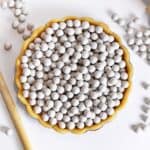
How To Blind Bake Pie Crust
This baking guide will teach you how to blind bake pie crust like a pastry pro! This comprehensive guide walks you through the entire blind baking process and offers plenty of tips and tricks to help you say goodbye to soggy crusts forever!
Servings: 6
Calories: 1kcal
Equipment
Ingredients
Pie dough
- 1 portion Pie dough try my all butter 3 ingredients pie crust or my extra flaky pie crust
- 1 portion Egg wash try my egg wash recipe
Instructions
- Make a pie dough and rest it in the fridge for at least 2 hours.
- Roll out to a 10-11 inch / 26-28 cm circle on a lightly floured surface.
- Transfer it to a 9-inch / 23 cm pie dish using only pushing movements. Trim, fold, and flute the edges. Freeze for 30 minutes.
- Meanwhile, preheat the oven to 390°F / 200°C with no fan, and place the rack in the lower-middle position.
- Crumple a sheet of parchment paper and press it firmly against the inside of the crust so it touches every surface. Fill with pie weights, pressing them up against the sides and bottom. Set the dish on a baking sheet.
- Stage 1: Bake at 390°F / 200°C for 20 minutes. The edges will start to look golden, but the bottom will still look undercooked.
- Remove parchment and weights. Prick the bottom all over with a fork. Cover the edges with foil if already golden. Stage 2: Bake for another 15 minutes at 390°F / 200°C until the bottom looks dry and just starts to color.
- Brush egg white wash over the bottom and sides of the crust. Brush the edges with egg yolk mixed with a small splash of milk for a glossy finish.
- Stage 3: Bake for a final 15 minutes at 390°F / 200°C until the crust is fully golden all over. Cover the sides with aluminum foil if browning too much.
- Use this blind-baked pie crust according to the recipe you are making.
Make ahead and storage
- A fully blind-baked crust keeps in the fridge for up to 5 days, tightly wrapped in plastic wrap, or at room temperature for 2 days. Freeze for up to 2 months and thaw at room temperature for about an hour before filling.You can also freeze the shaped, unbaked crust directly in the pie dish for up to 3 months. Bake straight from frozen and add 3 to 5 minutes to Stage 1.A par-baked crust keeps in the fridge for up to 3 days before you add the filling and finish baking.
Notes
INGREDIENT NOTES:
- All ingredients must be very cold throughout. Cold butter creates flaky layers; warm butter creates grease.
- Always weigh with a digital scale. Too much flour dries out the dough and causes it to crack.
- The egg white seals the inside against moisture. The egg yolk-milk mix gives the rim its shine. These two washes are applied at the same time for different purposes.
- Stop mixing the dough the moment it just comes together in the bowl. Overworking develops gluten, which makes the crust tough and prone to shrinking.
- Never skip the chill. At least 2 hours in the fridge lets the butter firm up again and the gluten relax.
- Push the dough into the dish; never stretch or pull. Tension in the dough causes it to shrink in the oven.
- Freeze the shaped crust before baking. Firm fat holds the structure in place while the oven comes up to temperature.
- Pack the pie weights all the way up against the sides, not just across the bottom, or the sides will still slip.
- Dock (fork-prick) only after the weights come out, not before — the weights do the job during the first stage.
- The bottom will puff slightly once the weights are removed. This is normal steam escaping; it settles as baking continues.
- Do not skip the egg wash. It is the most effective step for preventing a soggy bottom.
Nutrition
Calories: 1kcal | Carbohydrates: 0.1g | Protein: 0.01g | Fat: 0.04g | Saturated Fat: 0.01g | Polyunsaturated Fat: 0.01g | Monounsaturated Fat: 0.02g | Sodium: 1mg | Potassium: 0.2mg | Fiber: 0.01g | Vitamin A: 0.002IU | Calcium: 0.03mg | Iron: 0.01mg
