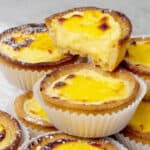
The BEST Hokkaido Baked Cheese Tarts (VIDEO)
Hokkaido Baked Cheese Tarts are the ultimate rich and creamy bite-sized Japanese desserts, with a crunchy shortcrust tart base and a distinct, sweet-and-savory, cheesy filling made from dairy and cheese products such as heavy cream, Philadelphia cream cheese, and parmesan.
Servings: 12
Calories: 323kcal
Equipment
Ingredients
For the mini tart shells
- 90 g Icing sugar
- 230 g Pastry flour can be replaced with All purpose flour
- 30 g Almond flour
- Pinch of salt
- 110 g Unsalted butter 82% fat content, use it very cold, cut into chunks
- 50 g Egg approx. 1 egg
For the cheese filling
- 230 g Cream cheese use full-fat, eg. Philadephia
- 50 g Parmesan cheese finely grated
- 45 g Unsalted butter 82% fat
- 50 g Whole milk
- 50 g Heavy cream
- 45 g Icing sugar
- 2 Egg yolk
- 15 g Corn starch
Instructions
For the tart shells
- Measure and cut butter into chunks and place it into the freezer for a few minutes
- Sift together dry ingredients; flour, icing sugar, almond, salt
- Add very cold butter chunks into the dry ingredients, and rub the mixture between your hands until it becomes a sand-like consistency
- Add egg into the mixture and mix with your hands just until the dough comes together
- Knead the dough with the palm of your hand for a minute or two, just until the dough becomes smooth. Do not over-knead the dough and do not use mixer, neither a food processor
- If the dough is too warm and sticky, place it into the fridge for 10-15 minutes first. Otherwise, continue with rolling the dough out into 2mm thickness between two Silicone baking mat.
- Place the dough into the freezer for 15 min in between the two Silicone baking mat. Do not remove the mat at this point
- Prepare your muffin pan or 12 mini tart molds
- Take the dough sheet out from the freezer, remove the top of the silicone mat, and cut out circles, using a cookie cutter
- With your fingers, press the dough circles into the tin one by one. Make sure that you work with a dough that is cold enough to be able to handle.
- Once you are ready with all the tart shells, poke them with a fork, then freeze the dough for 1 hour before baking
- Pre-heat oven to 180C / 356F (no fan) while the dough is in the freezer.
- Bake for 15 min in the muffin pan. After 15 minutes the pastry cases will somewhat contract within the pan so you will be able to easily remove them
- Once the tart cases are removed from the muffin pan to a baking sheet, bake for further 10-15 minutes at 160C / 320F (no fan). I suggest baking them in this second step upside down so the bottom of the tart case is up and can fully be baked until golden brown.
- They are ready when they achieve an even golden color, in about 25-30 minutes overall
Filling
- In a large enough bowl with the help of a hand whisk, whip together sugar and egg yolk until slightly fluffy for about 1-2 minutes the whisk in corn starch until thoroughly incorporated and have a smooth paste
- Heat milk, cream, butter, Philadephia cheese, and grated parmesan in a saucepan on low-medium heat, then remove it as soon as the ingredients melt together. By this time, the mixture probably will be simmering
- Pour the warm cheese mixture over the egg yolk mixture slowly while whisking vigorously with a hand whisk.
- Pour the mixture back into the saucepan and cook on medium heat for a few minutes until it thickens
- Place the filling into a shallow bowl and cover the entire surface with plastic wrap to avoid skin forming on top. Chill it for an hour before using it
Assemble
- Pre-heat oven to 220C / 428F (no fan)
- Fill each tart shells with the cheese filling using a piping bag
- Whisk one egg with a splash of water and apply a light egg wash on top of the filling
- Pop the tarts bake to the oven and bake for 5-10 minutes or until the top slightly caramelizes
- Serve the baked cheese tarts warm, room temperature or chilled
Video
Notes
INGREDIENT NOTES:
- Measure your ingredients with a Digital scale for accuracy
- Use high-quality 82% fat content European style very cold unsalted butter
- In case of nut allergy, almond can be replaced with an equal amount of flour
- Do not skip the salt in the tart shell
- In the filling use full-fat ingredients eg. cream, milk, cream cheese etc.
- If you prefer really sweet desserts, feel free to increase the quantity of the sugar, however, the Hokkaido Baked Cheese Tarts should not be sweet, like a cheesecake, more like sweet & savory
- Make sure you read my Expert tips section above to maximize your success. A short recipe alone is not able to cover all the necessary details, and science behind baking.
- While assembling and kneading the dough, work as quickly as possible without 1. overworking the dough 2. making the dough too warm. Kneading literally should not take more than a minute or two
- The temperature while working with this dough is super important. Too warm? The pastry dough will tear. Too cold? The pastry dough will break. Aim for the in-between, a cold enough dough that is comfortable to work with. Use your fridge or freezer to chill the dough if it gets too warm
- Do not worry if the inside of tart shells don't look perfect after baking, we will fill them anyway, no one will see it:)
- I strongly advise using a Digital oven thermometer to be able to measure your exact oven temperature
Nutrition
Calories: 323kcal | Carbohydrates: 28g | Protein: 7g | Fat: 21g | Saturated Fat: 12g | Polyunsaturated Fat: 1g | Monounsaturated Fat: 5g | Trans Fat: 1g | Cholesterol: 101mg | Sodium: 141mg | Potassium: 123mg | Fiber: 2g | Sugar: 12g | Vitamin A: 694IU | Calcium: 99mg | Iron: 1mg
