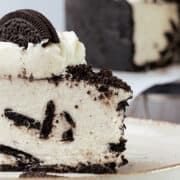
No Bake Oreo Cheesecake
Crunchy Oreo crust filled with creamy vanilla cream cheese mousse with hidden Oreo pieces
Servings: 8
Calories: 947kcal
Equipment
Ingredients
Oreo crust
- 110 g Unsalted butter
- 300 g Oreo Approx. 22 pieces with cream filling.
- Pinch of salt
Oreo cheesecake filling
- 3 Gelatine sheet 3x1.7g=5g gelatin overall
- 115 g Heavy Cream 36% fat
- 150 g Granulated sugar
- 2 teaspoons Lemon juice freshly squeezed
- 560 g Cream cheese full fat Philadelphia, cold
- 230 g Heavy Cream 36% fat, very cold
- 175 g Oreo Approx. 17 pieces with cream filling. Chop them into smaller pieces.
- 2 teaspoon Vanilla extract
Decoration
- 30 g Powdered sugar sifted
- 120 g Cream cheese full fat Philadelphia, cold
- 120 g Heavy Cream 36% fat, very cold
- Few Oreos
Instructions
Oreo crust
- Melt the butter and let it cool slightly. Crush whole Oreos (cream included) into fine crumbs using a food processor, or place them in a zip-top bag and crush with a rolling pin. Stir the crumbs with a pinch of salt, then add the melted butter and mix until evenly moistened.
- Press the mixture into the bottom and slightly up the sides of an 8-inch or 9-inch springform pan. Use the back of a spoon or a small measuring cup to press firmly and evenly without over-packing. Chill the crust in the refrigerator for at least 30 minutes (or 15 minutes in the freezer) before filling.
Oreo cream cheese filling
- Place the gelatin sheets in a small bowl of cold water and let them soak until softened.
- In a small saucepan, warm the smaller amount of cream with the sugar and lemon juice over medium heat. Stir until the sugar dissolves completely and the cream comes just to a simmer.
- Remove the saucepan from the heat. Squeeze out the excess water from the gelatin and whisk it into the hot cream until fully melted. Let this mixture cool to room temperature.
- In a large mixing bowl, whip the cream cheese with an electric hand mixer until smooth, light, and fluffy. Using a rubber spatula, gently fold the cooled gelatin mixture into the cream cheese until fully combined. At this stage, fold in the chopped Oreo pieces.
- In another bowl, whip the larger amount of heavy cream with the vanilla extract until it reaches the stage just before stiff peaks. At this point, the cream is stable enough to hold its shape but still smooth and flexible, making it easy to fold into the cream cheese mixture without losing volume. Stopping at soft peaks won’t provide enough stability, while whipping all the way to stiff peaks can quickly turn the cream lumpy, which doesn’t blend well with the other ingredients.
- Using a rubber spatula, gently fold the whipped cream into the cream cheese mixture. Work slowly and carefully so the mixture stays airy and fluffy.
- Pour the Oreo cream cheese filling into the prepared crust. Use an offset spatula to smooth the top evenly.
- Refrigerate for at least 6 hours, or preferably overnight, until the cheesecake sets.
- Once fully set, run a thin knife around the edge if needed, then gently release the springform ring to remove the cheesecake.
Decoration
- Whip the heavy cream, cream cheese, and powdered sugar together for 1–2 minutes until the mixture becomes light, fluffy, and pipeable. Stop as soon as it reaches the right consistency — overwhipping will cause it to turn runny.
- Move frosting into a piping bag fitted with Wilton 1M piping nozzle tip and pipe frosting on top. Decorate the cheesecake with a few Oreo pieces and crumb.
- StorageKeep the cheesecake covered in the refrigerator for up to 2-3 days. For best results, store it in the springform pan covered with plastic wrap or foil, or transfer slices to an airtight container.FreezingYou can freeze the whole cheesecake or individual slices. Wrap tightly in plastic wrap, then foil, and freeze for up to 1 month. Thaw overnight in the refrigerator before serving. Note that while the flavor stays delicious, the texture of the Oreos may soften slightly after freezing.
Notes
INGREDIENT NOTES:
- Measure your ingredients accurately using a digital scale.
- Do not skip the salt; it will balance the flavors.
- Ue full-fat, block-style cream cheese for the best texture and flavor. Low-fat or spreadable versions contain more water, which can make the cheesecake runny.
- Choose heavy cream with at least 36% fat content. It whips up more stable and gives the filling its light, mousse-like texture.
- The crust is sweet enough but for people with extra sweet tooth, feel free to add 1-2 tablespoons of granulated sugar to this recipe.
- The gelatin is not required but highly recommended if you want cleaner slices, a taller cheesecake, or if the cake needs to travel.
-
- When you make the crust, heat the butter in the microwave on low power so it does not explode. Alternatively, use a saucepan on the stovetop.
- When processing Oreos in a food processor, stop as soon as you have fine, sandy crumbs. If you overprocess, the cookies can release too much fat and turn pasty, almost like cookie butter.
- While preparing the Oreo crust, make sure that you press the crumbs firmly and evenly into the side and the bottom of your spring form.
- If using gelatin, let the warm cream-gelatin mixture cool to room temperature before folding it into the cream cheese. Adding it too hot can melt the cheese; adding it too cold can cause it to set in clumps. However, don't let it cool too much, e.g. don't place it into the fridge as the gelatin will set.
- The cream should be whipped to just before stiff peaks — stable enough to hold shape but still flexible. Too soft = filling won’t set; too stiff = it becomes lumpy and hard to fold in.
- When combining mixtures, always use a rubber spatula with slow folding motions. Stirring removes air and makes the filling heavier; if too much air is removed, it becomes runnier.
- The cheesecake needs time to firm up in the fridge — at least 6 hours, ideally overnight. Rushing this step is the number one reason for runny cheesecake.
Nutrition
Calories: 947kcal | Carbohydrates: 71g | Protein: 11g | Fat: 73g | Saturated Fat: 41g | Polyunsaturated Fat: 5g | Monounsaturated Fat: 21g | Trans Fat: 0.5g | Cholesterol: 181mg | Sodium: 516mg | Potassium: 313mg | Fiber: 2g | Sugar: 48g | Vitamin A: 2341IU | Vitamin C: 1mg | Calcium: 137mg | Iron: 7mg
