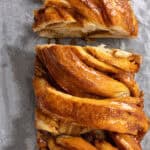
Cinnamon Babka
This cinnamon babka has a soft, buttery dough twisted in a cinnamon sugar filling and glossed with a light homemade sugar syrup. It is undoubtedly a crowd-pleaser!
Servings: 6
Calories: 444kcal
Equipment
Ingredients
Babka dough
- 120 g Whole milk lukewarm
- 30 g Granulated sugar
- 12.5 g Fresh Yeast check my yeast guide to convert it to dry yeast
- 1 Egg at room temperature
- 1 Egg yolk at room temperature
- 250 g Bread flour high protein content flour
- ¼ teaspoon Salt
- 80 g Unsalted butter room temperature, 82% fat content
Cinnamon sugar filling
- 55 g Unsalted butter at room temperature
- 50 g Brown sugar can be 50% granulated sugar and 50% brown sugar or granulated sugar only
- 1½ teaspoon Cinnamon
- Pinch of salt
Sugar syrup - optional
- 70 g Granulated sugar
- 15 g Lemon juice
- 60 g Water
Instructions
First day - first proofing of the dough
- Start with mixing half of the sugar with the lukewarm milk then sprinkle yeast on top. Make sure that the kitchen is nice and warm, and in 10 minutes, the yeast should start to foam.
- Pour in dry ingredients: bread flour, rest of the sugar, and salt, and start kneading it until the dough comes together. This will take about a minute or two.
- Then, slowly add the room-temperature (soft) butter chunks by piece to the dough. Once all the butter is in, knead the dough for another 10 minutes on medium-high speed until it becomes elastic and shiny and not too sticky.
- Move the dough into a bowl, cover it with plastic wrap and let it rest and rise in the fridge overnight for 12 hours.
- Alternatively, rise the dough for 1-2 hours at room temperature in a warm but not hot (avoid direct heat) spot in your kitchen. However, I do not recommend skipping the overnight rise, as the dough is much easier to handle while cold.
Second day
Make the cinnamon sugar filling
- Cream the room temperature butter, sugar and cinnamon for a few minutes until slightly increases in volume, then add a pinch of salt. Set it aside.
Second proofing
- Try to work quickly, and have everything you need - rolling pin, measuring tape, cinnamon sugar filling, a loaf pan with parchment paper prepared upfront. If the dough is warming up, pop it in and out of the freezer for a few minutes to chill between the steps, making sure the dough is always cold enough to work with and does not tear or stick. Refrain from using an excessive amount of flour, as that would make the cinnamon babka hard.
- Spread the cinnamon sugar filling on top and roll the dough up evenly and tightly from the shorter end, and then press to seal the end onto the roll. So you will end up with a 30cm / 12 inches long roll.
- If the dough is still nice and cold, continue with shaping. Otherwise, chill it first for about 5 minutes in the freezer. Cut the babka into half lengthwise, then place the logs over each other with the filling facing up and twist the logs with your hands on both sides.
- Cover the loaf pan with a kitchen towel and proof the cinnamon babka now the second time now at room-temperature. Proofing might take 1-2 hours, depending on your kitchen temperature. Wait until the dough doubles in size.
Baking
- Pre-heat your oven to 180C / 355F (no fan) towards the end of the proofing time. Then, once the babka is doubled in size, bake it at 180C / 355F for about 40 minutes. Bake until a skewer inserted comes out clean and the babka is golden brown. If it was browning too much, place aluminum foil on top towards the end of the baking time.
Syrupy glaze - optional
- For extra shine, towards the end of the baking time, make the syrup: boil water, sugar, and freshly squeezed lemon juice together until the mixture reaches a syrup consistency. Apply the syrup with a pastry brush on top of the hot babka. Let the babka slightly cool before removing it from the tin to a cooling rack - with the help of the parchment paper.
- Serve the cinnamon babka fresh. Any leftovers can be stored in an air-tight container at room temperature for 2-3 days.
Notes
INGREDIENT NOTES
- Always use unsalted butter in baking, in this recipe, the butter needs to be at room temperature so soft enough to be able to knead into the dough.
- Fresh or dried yeast can be used. My instant dried yeast pack says that 25g fresh yeast equals 7 g dried. Please check your local brand and calculate your yeast needs accordingly.
- Use the milk and egg at room temperature for the ingredients to properly emulsify.
- Since cinnamon babka is a sweet bread, use high protein content bread flour to make it.
- Experiment with different spices e.g. you could make delicious cardamom babka or pumpkin spice babka with the same recipe by replacing the cinnamon.
- For activating the yeast (whether it is dried or fresh), make sure that the milk is lukewarm and your kitchen is nice and warm.
- You will knead the dough for about 10 minutes in a stand mixer. The dough is ready when it is shiny, elastic and does not stick to your fingers any longer. Do not add more flour to the dough. If it sticks too much, continue kneading. Having said that, each flour is different, and I cannot guarantee the quality of your flour, so if the dough is still very sticky after 10-15 minutes of kneading, you might need to add a tiny bit more flour.
- The kneading process is most convenient with a stand mixer. I do not recommend using a handheld mixer as you can easily burn that machine down with this quantity. I must say that my Mom has been making yeasted dough with her hands for decades, so if you are strong enough like my Mom, it is not impossible. However, you will need strong hands and a proper hand-kneading technique, and it will take a minimum of 30 minutes.
- Overnight proofing is recommended for the best results. It is much easier to handle (roll, shape) a dough that is risen in a chilled environment. However, if you want babka the same day, you can try to make the first rise at room temperature and continue from there as per my recipe.
- To make the filling, it is best if you whip up the butter a bit with the sugar and cinnamon, it will be easier to spread. Also, make sure that the filling stays at room temperature. If the filling is too warm (melted butter), you won´t be able to properly roll it up, and it can also melt the dough. If the filling is too cold, you won't be able to spread it properly on top of the dough.
- During the rolling, filling, and shaping process, try to work with a chilled dough that does not stick or tear. Any moment if the dough gets too warm and uncomfortable to deal with, pop it into the freezer for a few minutes, then continue.
- Second proofing is necessary for the perfect rise = fluffy texture, do not skip it.
Nutrition
Calories: 444kcal | Carbohydrates: 57g | Protein: 7g | Fat: 21g | Saturated Fat: 13g | Polyunsaturated Fat: 1g | Monounsaturated Fat: 6g | Trans Fat: 1g | Cholesterol: 110mg | Sodium: 123mg | Potassium: 119mg | Fiber: 1g | Sugar: 26g | Vitamin A: 680IU | Vitamin C: 1mg | Calcium: 57mg | Iron: 1mg
