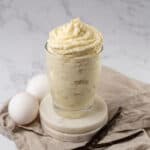
Bavarian Cream (Crème Bavaroise)
Also known as Creme Bavarois, Bavarian cream is a light, vanilla-flavored cream that you can use as a filling, frosting, or as a dessert served on its own.
Servings: 4
Calories: 366kcal
Ingredients
- 250 g Whole Milk 3% fat
- 75 g Granulated sugar
- 60 g Egg yolk yolk of approx. 3 eggs
- 2 teaspoon Vanilla extract
- 4 Gelatin sheets or 6.8g (1.5 teaspoon) gelatin powder
- 230 g Heavy cream 36% fat, use it very cold
Instructions
- Soak the gelatin sheets in cold water.
- In a large enough bowl, with the help of a Hand whisk, whisk together sugar, egg yolk and the vanilla until slightly fluffy for about 1-2 minutes.
- Bring milk to simmering in a saucepan on medium heat. Make sure it is simmering but not boiling.
- Pour the warm milk mixture over the egg yolk mixture slowly while whisking vigorously with a Hand whisk. This stage is effectively tempering the egg yolks.
- Pour the mixture back into the saucepan and cook on medium heat until temperature reached 82C / 180F.
- Remove the cream from the stove as soon as cream reaches the desired temperature. Do not cook it further as the mixture will curdle.
- Squeeze excess water from the gelatin sheets and stir them into the hot cream. Alternatively, if using gelatin powder, mix together the gelatin powder with 1 tablespoon of cold water then when thickened into a paste, immediately mix into the warm custard.
- Place the custard into a shallow bowl or container and cover the entire surface with plastic wrap to avoid skin forming on top. Let it come to room temperature in about an hour. Do not let it chill as the gelatin will set too hard.
- Once the custard is at room temperature, whip very cold heavy cream until early stiff peaks. Do not overbeat.
- Fold the whipped cream very gently into the custard in 2-3x portions.
- As a filling, you can use this Bavarian cream straight away. As a frosting to pipe, chill it for 2-3 hours for the gelatin to set.
- As an individual dessert, pour the cream into your mold and refrigerate it for a minimum of 4 hours. Also, you might want to increase the gelatin in the recipe to be able to neatly unmold the dessert.
Notes
INGREDIENT NOTES:
- Measure your ingredients with a Digital scale for accuracy.
- High-fat content milk and pure vanilla extract are the heart of making Bavarian Cream.
- Fresh, farm eggs will provide bright yellow color cream, while cheaper supermarket eggs will result in a pale cream.
- You will want to use high-fat content heavy cream (36%) and it has to be very cold before whipping up.
- I am using 4 gelatin sheets that can be substituted with 6.8g gelatin powder. Check my gelatin guide to learn more about how to with gelatin sheets vs powder.
- Make sure you read my Expert tips section above to maximize your success. A short recipe alone is not able to cover all the necessary details, and science behind baking.
- Do not heat the mixture further than 82C / 180F as the egg will curdle.
- Make sure to let the custard come to room temperature before folding the whipped heavy cream in.
- When whipping the cream, you will want to reach early stiff peaks; stiff peaks (or firm peaks) stand straight up when the mixer is lifted, and the tips don't curl. However, stop whipping as soon as you reach stiff peaks as once you over-whip the cream and it will become very stiff, the texture won´t be smooth enough to fold in with the custard.
Nutrition
Calories: 366kcal | Carbohydrates: 24g | Protein: 8g | Fat: 27g | Saturated Fat: 16g | Polyunsaturated Fat: 2g | Monounsaturated Fat: 7g | Cholesterol: 234mg | Sodium: 51mg | Potassium: 168mg | Sugar: 24g | Vitamin A: 1163IU | Vitamin C: 0.3mg | Calcium: 136mg | Iron: 1mg
