Profiteroles
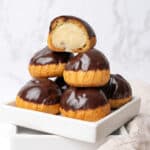
Featuring a crisp choux pastry shell, luscious pastry cream filling, and a decadent, glossy chocolate glaze, every bite of these easy profiteroles is like a taste of heaven!
Servings: 16
Calories: 178kcal
Equipment
Ingredients
For the profiteroles
- 60 g Unsalted butter 82% European style butter at room temperature, in chunks.
- 60 g Water
- 60 g Whole milk
- ¼ teaspoon Salt
- 1 teaspoon Granulated sugar
- 70 g Bread flour high protein content flour, eg. 13%
- 110 g Egg Approximately 2 eggs at room temperature. Might need slightly more or less; see the tips below.
Pastry cream filling
- 240 g Whole milk 3% fat
- 50 g Granulated sugar
- 40 g Egg yolk approximate yolk of 2 eggs
- 12 g Corn starch
- 12 g All purpose flour
- 1 teaspoon Vanilla extract
- 28 g Unsalted butter 82% fat, at room temperature
Chocolate ganache glaze
- 170 g Semi sweet chocolate use high quality chocolate e.g., Callebaut or Lindt
- 77 g Heavy Cream 36% fat
- 15 g Unsalted butter 82% fat, at room temperature
Instructions
Classic Profiteroles step-by-step
- Sift the flour and set aside. In a saucepan, combine butter, water, milk, salt, and sugar. Heat over medium until simmering, but don’t allow it to boil.
- Remove the saucepan from heat, then add the flour all at once. Stir vigorously with a rubber spatula until a smooth dough forms, with no visible flour. Return to the heat and cook for 3-5 minutes, stirring constantly, until a thin skin forms on the bottom of the pan and some of the liquid evaporates.
- Transfer the dough to the bowl of a stand mixer. Using the paddle attachment, mix on low for about a minute to cool slightly. Gradually add the lightly whisked eggs, a little at a time, allowing each addition to fully incorporate before adding more. The dough should become glossy and pipeable in about 2-3 minutes.
- When ready, the dough should fall off the paddle in a V shape. It shouldn’t be runny. The exact egg amount may vary based on moisture loss during cooking and flour type, so adjust as needed.
- Transfer the dough to a pastry bag fitted with a 0.5-inch French star nozzle. Refrigerate for 1 hour for the best results.
- After resting, pipe 16 evenly sized profiteroles onto a perforated baking mat, leaving space for puffing, or pipe onto a parchment-lined baking sheet. Pipe at a 90° angle (holding the piping bag straight vertically) with even pressure. Smooth the tips by tapping them lightly with a wet finger.
- Lightly dust with powdered sugar to prevent cracking. Freeze for at least one hour, or store for longer if needed.
- Preheat the oven to 200°C / 392°F (no fan). After freezing, place the tray in the oven, reduce the temperature to 170°C / 338°F (no fan), and bake for 30 minutes. Avoid opening the oven for the first 20 minutes. If you're baking for the first time, remove one profiterole after 30 minutes to check. It should be golden, puffed up, and not deflate at room temperature.
- Let the profiteroles cool on the perforated mat at room temperature before filling and glazing.
Pastry cream filling
- Whisk the sugar and egg yolks in a bowl for 1-2 minutes until fluffy. Then, add the cornstarch, flour, and vanilla, and mix until smooth.
- In a saucepan, heat the milk over medium heat until it begins to simmer (but not boil). Gradually pour the hot milk into the egg yolk mixture while whisking constantly to temper the yolks.
- Return the mixture to the saucepan and cook over medium heat, stirring continuously, until it thickens (about 1 minute after boiling). If the mixture is lumpy, continue whisking until smooth. Remove from heat and strain if needed.
- Gradually add the softened butter in chunks, mixing until fully incorporated.
- Allow the pastry cream to cool completely before using it to fill the profiteroles. Transfer the cream to a shallow bowl and cover the surface with plastic wrap.
Chocolate ganache glaze
- The quantity is enough to glaze all 16 profiteroles, with some left to pour on top when serving.
- For the glaze, semi-melt the chocolate in the microwave.
- Meanwhile, heat the cream in a saucepan until it just begins to simmer. Pour the simmering cream over the melted chocolate and stir until smooth, then mix in the butter.
- Set aside and allow the glaze to cool to about 30°C (86°F). It should have a smooth consistency—not too runny or thick—before use.
Fill and glaze the profiteroles
- To fill the profiteroles, create a small hole on the bottom using a skewer or piping nozzle. Move the pastry cream into a piping bag fitted with a small round nozzle tip and pipe the cream into the profiteroles until fully filled.
- Once filled, dip the tops of the filled profiteroles into the cooled chocolate glaze, ensuring an even coat. Gently tap to remove any excess glaze or clean up with your fingers.
- Let the glaze set in the fridge for 2-3 minutes for a glossy finish.
- Profiteroles are best enjoyed immediately after filling, as they lose their crispiness over time. Any leftovers can be stored in the fridge for up to a day.
Notes
INGREDIENT NOTES:
- Measure your ingredients with a digital scale for accuracy
- For making any choux pastry, use high protein content bread flour for the best results, I am using 12% protein content flour. Do not skip the salt, and use lightly whisked room-temperature eggs.
- Good quality butter and pure vanilla extract are the heart of making pastry cream. Use high-quality 82% fat-content European butter and the best quality vanilla you can access.
- For the chocolate glaze, use good quality semi-sweet chocolate, e.g., Callebaut or Lindt.
- While heating the milk, water, butter, salt, and sugar mixture, ensure the sugar and salt fully dissolve. It is best to start with room-temperature butter so the mixture will melt together at the same time.
- Do not skip sifting flour, as you don't want to deal with flour lumps while making this recipe.
- Please note that you might need slightly more or less egg - and that is normal - depending on the flour you use and how much you dried the mixture while cooking it. Pay very close attention to consistency while mixing the egg and applying the V-shape test.
- There are two chilling times involved - one fridge resting before piping and one freezing before baking. Both of them are important to achieve neat, crack-free results.
- Use a closed star nozzle tip so your profiteroles will puff up neatly. Neither round nor open star nozzle tip will give you the desired results.
- I strongly advise using a digital oven thermometer to measure your exact oven temperature, as most home ovens are either over or under-heat.
- While baking, do not use the fan in your oven, it can encourage cracks on your profiteroles.
- Use a small/medium-sized saucepan with good heat distribution to avoid burning the milk when making pastry cream.
- Let the cream set in the fridge before using. It will further set as it cools into a silky, pipeable consistency.
- While glazing, you want to make sure that the ganache is at the right temperature. If it is too thick (cold), the glaze will set in a wrinkled way. If it is too thin (warm), the glaze will run to the side. Test and try with one profiterole and wait for the right temperature to glaze the rest.
Nutrition
Calories: 178kcal | Carbohydrates: 15g | Protein: 3g | Fat: 12g | Saturated Fat: 7g | Polyunsaturated Fat: 1g | Monounsaturated Fat: 3g | Trans Fat: 0.2g | Cholesterol: 59mg | Sodium: 57mg | Potassium: 111mg | Fiber: 1g | Sugar: 8g | Vitamin A: 299IU | Vitamin C: 0.03mg | Calcium: 41mg | Iron: 1mg
