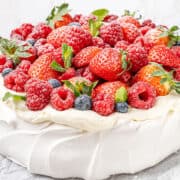
Pavlova Cake
This Pavlova Cake is the perfect dessert for Spring and Summer. Perfectly baked meringue that's crunchy on the outside and marshmallow on the inside, with freshly whipped cream and juicy berries on top.
Servings: 6
Calories: 347kcal
Ingredients
Pavlova
- 180 g Egg whites whites of approx. 6 eggs (approx.)
- 300 g Super fine sugar If you don’t have superfine sugar, you can pulse regular granulated sugar in a food processor for a few seconds until it’s finer but not powdered.
- 1½ teaspoon Cream of tartar can be substituted with ½ tablespoon freshly squeezed lemon juice or vinegar
- 1 tablespoon Corn starch
- ½ tablespoon Vanilla extract
- ¼ teaspoon Salt
Filling
- 230 g Heavy cream 36% fat content, use it very cold
- 30 g Powdered sugar
- 1 teaspoon Vanilla extract
- Fresh berries
- Powdered sugar
- Mint
Instructions
- Preheat the oven to 195°F (90°C), no fan. Line a baking tray with parchment paper or use a silicone baking mat. Double-check your oven’s true temperature with a digital oven thermometer if you have one—it really makes a difference for pavlova.
- You’ll need something acidic to help stabilize the egg whites. You can use cream of tartar, lemon juice, or vinegar. If using cream of tartar, begin whisking room temperature, fresh egg whites on low speed in a stand mixer with the cream of tartar added right at the start. If using vinegar or lemon juice, wait until the egg whites are foamy before adding one of them.
- Once the egg whites are foamy, start adding the superfine sugar slowly—one tablespoon at a time—while increasing the mixer speed to medium-high. Be patient; this step is crucial.
- After all the sugar has been added, whip the meringue on high speed until it becomes thick, glossy, and holds stiff peaks. Test a small amount between your fingers—if it feels gritty, keep whisking. You want the sugar to fully dissolve without overwhipping the meringue, which can cause it to become lumpy and unstable.
- At this point, add the vanilla extract and salt, then whip it for a few more seconds.
- Then, using a rubber spatula, gently fold in the cornstarch, being careful not to deflate the meringue.
- Spread or pipe the meringue onto the prepared tray in an 8-inch (20 cm) circle. Shape it with a spoon or spatula so that the edges are slightly taller and there’s a shallow dip in the center to hold your filling later. You can make decorative swoops or peaks on the sides if you like.
- Bake for 2½ hours at 195°F (90°C). Begin checking it around the 2-hour mark. The pavlova should feel dry to the touch.
- Once baked, turn off the oven and leave the door slightly open. Let the pavlova cool completely inside the oven for several hours to prevent cracking.
- Before serving, whip cold heavy cream and powdered sugar until soft peaks form, then add the vanilla and continue whipping just until fluffy and pipeable.
- Decorate with fresh fruits, mint, and powdered sugar, if desired.
- Undecorated pavlova storage: Store in an airtight container at room temperature for up to 2 days. Keep it in a cool, dry place away from humidity—never in the fridge, as moisture will make it sticky and soggy.Decorated pavlova storage (with cream and fruit): Once topped, pavlova should be served immediately or stored in the refrigerator for up to 1 day. After that, the meringue will start to soften and lose its crisp texture.
Notes
Ingredient Notes
- Use fresh, room-temperature egg whites for the best volume and stability. Avoid carton egg whites—they don’t whip up as well. Make sure there's no trace of yolk.
- Superfine sugar dissolves more easily into the meringue, resulting in a smoother texture. If you only have granulated sugar, pulse it briefly in a food processor.
- Acid (Cream of Tartar, Lemon Juice, or Vinegar): A small amount helps stabilize the egg whites and strengthens the meringue structure. Choose one and add it at the right time depending on the type (see technique notes).
- Cornstarch is the secret to the pavlova’s marshmallow-like center. It softens the inside while keeping the shell crisp.
- Use high-quality vanilla extract for the filling; try my homemade vanilla extract.
Technique Notes
- To start, make sure all your equipment—mixing bowl, whisk, and spatula—is completely clean and dry. Even the tiniest bit of fat or egg yolk can prevent the egg whites from whipping properly, so take extra care when separating the eggs. Arrange everything you need ahead of time for a smooth process.
- Start at a low speed to build small, stable bubbles, then gradually increase speed. This creates a more stable meringue.
- Stop whipping the meringue once it´s glossy and forms stiff peaks. Overwhipping can cause the meringue to collapse or become lumpy.
- Do not take out the pavlova from the oven straight after baking. Letting it cool in the oven while the door is slightly open prevent cracking.
Nutrition
Calories: 347kcal | Carbohydrates: 58g | Protein: 4g | Fat: 14g | Saturated Fat: 9g | Polyunsaturated Fat: 1g | Monounsaturated Fat: 3g | Cholesterol: 43mg | Sodium: 61mg | Potassium: 211mg | Fiber: 0.01g | Sugar: 51g | Vitamin A: 564IU | Vitamin C: 0.2mg | Calcium: 28mg | Iron: 0.1mg
