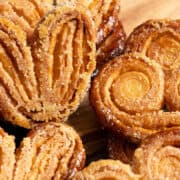
Palmiers
Crisp, caramelized French pastry cookies made with just two ingredients; puff pastry and sugar, in 40 minutes.
Servings: 28
Calories: 110kcal
Ingredients
Apple
- 1 pack Puff pastry store-bought or 1 portion of my homemade rough puff pastry
- 100 g Granulated sugar
Instructions
- Thaw puff pastry in the fridge until pliable but still cold, or make my easy rough puff pastry.
- Line 2 baking sheets with parchment paper; there's no need to grease them, as the puff pastry contains enough fat.
- Dust your work surface with sugar, not flour. Lay the pastry on top and sprinkle more sugar over the surface. Roll lightly with a rolling pin to press the sugar into both sides.
- Shape using one of two methods. Fold method: fold both long edges inward to meet in the center, leaving a small gap; fold inward again, then fold one half over the other like closing a book. Roll method: roll both short edges tightly toward the center until they meet in the middle. Keep folds tight throughout.
- Wrap the shaped log and freeze it for at least 20 to 30 minutes.
- Preheat oven to 200°C / 390°F (no fan).
- Slice the chilled log into 1 cm / ½ inch pieces using a sharp knife with a single confident cut. One by one, dip each slice into the remaining sugar on the work surface to coat, then place cut-side up on a parchment-lined baking sheet with plenty of space between each cookie.
- Bake the cold dough at 200°C / 390°F (no fan) for 12 to 15 minutes or until the base is bubbling and caramelized. Flip and bake for a further 8 to 10 minutes until deep golden brown. Check the base color before removing from the oven.
- Cool on the tray for 5 minutes, then transfer to a wire rack. They will crisp up as they cool.
- Store in an airtight container at room temperature for up to 3 days. To make ahead, freeze raw slices and bake straight from frozen, adding 2 to 3 minutes per side.
Notes
- If the pastry softens at any point during the rolling or folding, return it to the fridge for a few minutes before continuing.
- Check the bottom of the pastry - whether it is well baked - before taking the Palmiers out of the oven
- Try this palmiers recipe with cinnamon sugar for a lovely cinnamon palmiers
Nutrition
Calories: 110kcal | Carbohydrates: 11g | Protein: 1g | Fat: 7g | Saturated Fat: 2g | Polyunsaturated Fat: 1g | Monounsaturated Fat: 4g | Sodium: 44mg | Potassium: 11mg | Fiber: 0.3g | Sugar: 4g | Vitamin A: 0.2IU | Calcium: 2mg | Iron: 0.4mg
