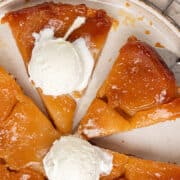
Apple Tarte Tatin
Buttery-soft, caramelized apples on a flaky puff pastry base make an Apple Tarte Tatin one of the most elegant French desserts there is.
Servings: 8
Calories: 523kcal
Ingredients
- 5-6 Apples e.g. Granny Smith
- 1 tablespoon Lemon juice freshly squeezed
- 150 g Granulated sugar
- 60 g Unsalted butter
- 1 tablespoon Lemon juice freshly squeezed
- ¼ teaspoon Salt
- 1 pack Puff pastry store-bought or homemade
Instructions
- Peel, core, and halve the apples. Sprinkle with freshly squeezed lemon juice to prevent discoloration.
- Preheat the oven to 350°F (175°C), no fan.
- Place a heavy, ovenproof skillet or tarte Tatin pan (9-inch / 23 cm) over medium heat. Add the sugar, butter, and lemon juice, and cook gently until the mixture turns a light golden caramel. If the butter begins to separate from the sugar, whisk the mixture until it comes back together. Remove it from the heat and add the salt.
- Place the apple halves cut-side up in the caramel, packing them tightly since they will shrink while baking. Continue layering if needed to create a full, even base.
- Place the pan with the apples into the oven and bake for about 20 minutes at 350°F (175°C). Check their consistency; they should be only half-baked at this stage. Let them cool to room temperature before placing the pastry on top.If the apples release too much liquid, carefully spoon out the excess. At this point, the apples should be moist with caramel underneath, but not sitting in a watery sauce.
- Roll out the chilled dough into a circle about 11–12 inches (28–30 cm) in diameter, slightly larger than your skillet so it can cover the apples and tuck around the edges. Prick it all over with a fork before placing it over the apples.
- Place the puff pastry over the apples, tucking the edges down around the fruit. Bake in a preheated oven at 375°F (190°C) for about 25–30 minutes, until the pastry is golden brown and crisp.
- Let the tart rest for 15 minutes. Before flipping it onto a serving plate, check if there is too much liquid in the pan. If so, spoon out the excess. Don’t discard it: as it cools, the sauce will thicken into a rich caramel, which you can later brush over the apples for a glossy finish.Then, carefully invert it onto a serving plate while still warm to prevent the caramel from hardening.
- Slice and serve warm, with whipped chantilly, or vanilla ice cream.
- Store leftover tarte Tatin covered in the refrigerator for up to 3 days. Rewarm slices gently in the oven at 300°F (150°C) for about 10 minutes before serving to bring back the caramel’s shine and crisp up the pastry slightly.Tarte Tatin is best enjoyed fresh, but you can freeze it if needed. Wrap the cooled tart tightly in plastic wrap, then in aluminum foil, and freeze for up to 1 month. To serve, thaw overnight in the refrigerator, then reheat in a 325°F (160°C) oven until warmed through. Keep in mind that the pastry may lose some of its crispness after freezing.
Notes
- Use a type of apple that is both firm and crisp in texture, like Granny Smith or Honeycrisp. Softer apples can fall apart and turn to mush.
- The simplest and most reliable method is to cook the sugar and butter together with a splash of lemon juice until you get a very light caramel. Don’t push it too far; the caramel will continue to deepen in the oven, and starting too dark can leave you with a bitter taste.
- Apples shrink significantly while cooking. Pack the skillet tightly, prebake them, then rearrange the tart so it looks full and even.
- Baking the apples before adding the puff pastry not only helps reduce shrinkage but also prevents the pastry from turning soggy.
- After prebaking, if the apples have released too much juice, spoon it out so you’re left with just moist apples sitting in caramel, not watery sauce.
- Puff pastry softens quickly at room temperature. Roll it out while still chilled and only place it over the apples once they’ve cooled slightly; never cover hot apples, or the pastry will melt before baking.
- Once the tart is fully baked, let it rest for a few minutes before flipping. If there’s still too much caramel in the pan, spoon some out first; this keeps the serving plate neat. As the sauce cools, it thickens into a rich caramel that you can brush over the apples for a glossy finish.
- You can flavor the tarte tatin by adding cinnamon, cardamom, vanilla extract or apple pie spice to the caramel along with the salt.
Nutrition
Calories: 523kcal | Carbohydrates: 62g | Protein: 5g | Fat: 30g | Saturated Fat: 10g | Polyunsaturated Fat: 3g | Monounsaturated Fat: 15g | Trans Fat: 0.2g | Cholesterol: 16mg | Sodium: 227mg | Potassium: 165mg | Fiber: 4g | Sugar: 31g | Vitamin A: 250IU | Vitamin C: 7mg | Calcium: 15mg | Iron: 2mg
