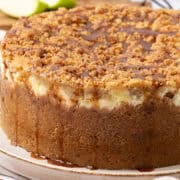
Apple Crumble Cheesecake
This Apple Crumble Cheesecake is the perfect mixture of warm cinnamon apples, comforting crumble, and a rich, tangy cheesecake. It has the most amazing flavor and texture, and it's the perfect treat for Fall that works for any occasion.
Servings: 8
Calories: 922kcal
Equipment
Ingredients
Apple Crumble Cheesecake
Apple topping
- 800 g Apples e.g. Granny Smith. This quantity is about 4 apples depending on the size.
- 1 tablespoon Lemon juice freshly squeezed
- 110 g Brown sugar
- 1 tablespoon Cinnamon
- 1 tablespoon Corn starch
Crumble
- 110 g Unsalted butter room temperature
- 100 g Granulated sugar
- 50 g Brown sugar
- 150 g All purpose flour
- ¼ teaspoon Cinnamon optional
- Pinch of salt
Crust
- 200 g Graham Cracker Crumbs 200 g = 7 oz = approx. 13 sleves
- 80 g Unsalted butter
- Pinch of salt
- ½ teaspoon Cinnamon optional
Cheesecake batter
- 680 g Cream cheese full fat Philadephia at room temperature
- 200 g Granulated sugar
- 170 g Sour cream full-fat at room temperature
- 1 tablespoon Lemon juice freshly squeezed
- 2 teaspoon Vanilla extract
- Pinch of salt
- 3 Eggs lightly whisked at room temperature
Instructions
Start with the apples
- Peel, core, and slice the apples into even pieces. Toss them with lemon juice while cutting to prevent browning.
- Then, cook the apples with the sugar and cinnamon in a pan on the stove for 3–5 minutes until slightly softened but not fully cooked. Remove the apples and set aside. We will use these apples to bake in and on top of the cheesecake.
- Mix a few tablespoons of the hot apple sauce with cornstarch until smooth, then stir it back into the pan. Cook for about 1 minute until thickened. We will use this apple caramel sauce as a topping after the cheesecake is baked.
- Let both the apple mixture and the apple sauce cool to room temperature.
Crumble
- Cut butter into small chunks and let it come to room temperature. Whisk together the flour, salt, granulated sugar, brown sugar, and cinnamon, then add the room temperature butter chunks to the mixture and mix with a spatula or wooden spoon just until the dry ingredients are coated with the butter.
- You can make sand-like crumbs or larger crumbs by simply pressing the mixture together with your fingers. Place the crumble into the fridge to chill while preparing the rest of the cheesecake elements.
Crust
- Melt the butter gently in the microwave or on the stovetop until fully liquid, then set aside to cool slightly. Crush the graham crackers into fine crumbs in a food processor or by placing them in a zip bag and rolling with a pin.
- Stir a pinch of salt and the cinnamon into the crumbs, then add the melted butter and mix until the texture resembles wet sand.
- Press the mixture evenly into the bottom and sides of an ungreased 8- or 9-inch springform pan using the back of a spoon or measuring cup. Apply firm, even pressure without over-packing, then chill in the fridge/freezer while preparing the filling.
- Bake the crust in a preheated 350°F (175°C) oven for 8–10 minutes, until lightly golden and set. Remove it from the oven and let the crust cool completely in the pan before pouring in the cheesecake batter.
Water bath preparation
- Preheat the oven to 325°F (165°C), no fan, and prepare a roasting pan for the water bath that is bigger in size, than your springform pan. Set it aside.
- Wrap the outside of the springform pan containing the crust in a mininum of 4-5 layers of heavy-duty aluminum foil, covering the bottom and sides to prevent leaks. For extra protection, you can also place the foil-wrapped pan inside a large oven-safe bag.
Cheesecake batter
- Place the room temperature full-fat cream cheese into the bowl of a stand mixer fitted with the paddle attachment. Cream the cream cheese on medium-low speed for 2 minutes until smooth and lump-free. Scrape down the sides and bottom of the bowl.
- Add the granulated sugar and continue creaming on medium-low speed for 2 minutes until the mixture looks silky and no longer grainy. Scrape down the bowl again.
- Add the room temperature sour cream, freshly squeezed lemon juice, vanilla, and a pinch of salt. Mix on low speed just until combined, about 10 seconds. Scrape down the bowl once more.
- Lightly whisk the room-temperature eggs in a small bowl until just blended. With the mixer running on low speed, slowly add the eggs. Mix only until fully incorporated, about 30 seconds. Once the batter is smooth and uniform, stop mixing.
Assemble the cheesecake
- Layer the cheesecake in the prebaked crust in the following way from bottom to top:½ of the cheesecake batter½ of the apple compote½ of the cheesecake batter½ of the apple compoteAll the crumble.
- Press the crumble layer very gently on top, and then move it onto the roasting pan. Carefully pour hot water into the roasting pan until it reaches about thirdway up the sides of the springform pan, then transfer it with the cheesecake and water into the oven.
- Bake the cheesecake in the water bath at 325°F (165°C) for 75-85 minutes, until the edges are set but the center is still slightly jiggly when gently shaken. Do not open the oven door during baking.
- After the baking time is over, turn off the oven but leave the cheesecake inside the closed oven for another 60 minutes. After 60 minutes, remove the roasting pan from the oven and carefully lift the cheesecake out of the water bath. Unwrap the foil and place the pan on a wire rack. Let it cool at room temperature for about 1 hour.
- Once the cheesecake has cooled to room temperature, place it in the refrigerator to chill for at least 6 hours, or overnight, until fully set. Only after chilling, release the springform pan and remove the cheesecake carefully.
- Remove the cheesecake from the refrigerator and let it sit at room temperature for about 20–30 minutes before slicing. Serve it with the apple caramel we prepared while cooking the apples.
- StoringOnce the cheesecake has chilled and set, cover any leftover with plastic wrap or aluminum foil, and store it in the refrigerator for up to 3–4 days to maintain freshness and prevent it from drying out.FreezingAfter the cheesecake has fully chilled, wrap the whole cake (still in the springform pan) or individual slices tightly in plastic wrap, then add a layer of aluminum foil for protection; freeze for up to 2–3 months, and when ready to serve, transfer to the refrigerator to thaw slowly overnight for the best texture.
Notes
INGREDIENT NOTES:
- Measure your ingredients with a digital scale for accuracy.
- Do not skip the salt; it will balance the flavors.
- Feel fee to substitute Graham cracker with Digestive biscuits.
- The crust is sweet enough, but for people with an extra sweet tooth, feel free to add 1-2 tablespoons of granulated sugar to this crust recipe.
- For the cheesecake batter, use full-fat ingredients at room temperature.
- Freshly squeezed lemon juice gives a better flavor than bottled.
- Good quality vanilla extract or paste makes a big difference.
- Feel free to experiment with different spices, e.g. ginger, apple spice, cardamom.
- Make sure you read my step-by-step instructions in the post above with all the details of how to make this cheesecake crust. A short recipe alone is not able to cover all the necessary details and science behind baking.
- The butter should be fully runny so it mixes well with the crumbs, but not hot, otherwise it can make the mixture greasy.
- When processing graham crackers in a food processor, stop as soon as you have fine, sandy crumbs. If you overprocess, the crackers can release too much fat and turn pasty, almost like cookie butter.
- While preparing the crust, make sure that you press the crumbs firmly and evenly into the sides and the bottom of your springform.
- To avoid a crust that’s too hard, don’t over-pack the crumbs. Firm pressure is enough — pressing too tightly can make it difficult to cut clean slices later.
- Use the paddle attachment, not the whisk, to avoid whipping air into the batter.
- Mix on low speed and scrape down the bowl often for a smooth, lump-free texture.
- Do not overmix after adding eggs — this prevents excess air and cracks.
- Do not skip cooking the apples as they will release a lot of water. However, do not overcook them neither.
- Since the top of the cheesecake will be covered with apples and crumb, you can optionally skip the water bath. However, the water bath not only helps avoid cracks on the top of cheesecake but also contributes to even baking throughout.
- Allow slow cooling in the oven before chilling to avoid sinking or splitting.
- Do not cut the cheesecake until it has fully set in the refrigerator.
- Use a sharp knife dipped in hot water and wiped clean between each cut for neat slices.
Nutrition
Calories: 922kcal | Carbohydrates: 98g | Protein: 10g | Fat: 57g | Saturated Fat: 32g | Polyunsaturated Fat: 3g | Monounsaturated Fat: 15g | Trans Fat: 1g | Cholesterol: 211mg | Sodium: 472mg | Potassium: 356mg | Fiber: 4g | Sugar: 77g | Vitamin A: 2014IU | Vitamin C: 6mg | Calcium: 174mg | Iron: 2mg
